

Posted on 28th Aug 2026
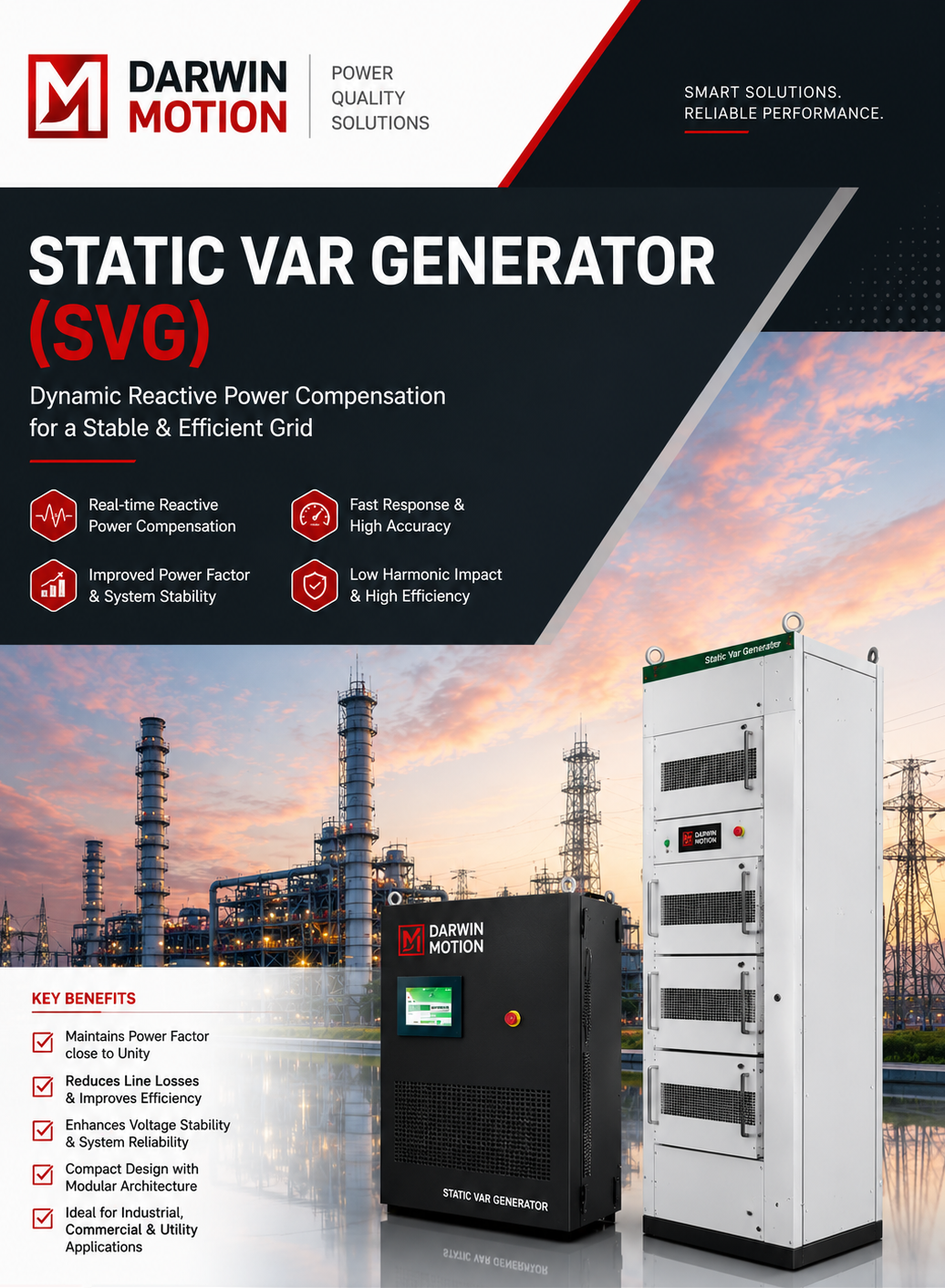
Modern electrical installations are increasingly dependent on equipment that consumes reactive power. Motors, compressors, pumps, welding machines, HVAC systems, Variable Frequency Drives (VFDs), transformers and other industrial loads can cause the power factor of an electrical system to fluctuate during operation. Conventional capacitor-based correction systems may not always respond effectively when the load changes rapidly.
An SVG Panel provides a modern approach to reactive power compensation. SVG, or Static Var Generator, is a power-electronic solution that dynamically generates or absorbs reactive current according to the instantaneous requirements of the electrical system.
Darwin Motion, a reputed AC Drive manufacturer and power quality solution provider, offers Static Var Generator technology for industrial, commercial and infrastructure applications where stable power factor and efficient electrical performance are important.
An SVG Panel is an electrical power quality panel incorporating a Static Var Generator to provide continuous reactive power compensation. Unlike conventional capacitor banks that operate through predefined switching steps, an SVG can continuously adjust its compensation output according to changing load conditions.
The SVG monitors the electrical system, determines the reactive power requirement and injects either leading or lagging reactive current as required. This makes the technology particularly useful for facilities where the electrical load changes frequently.
Many electrical loads require reactive power to establish magnetic fields and perform their intended functions. Although reactive power does not directly perform useful mechanical work, it increases the current flowing through the electrical distribution system.
A low power factor can therefore result in higher current demand for the same amount of useful power. This can increase losses and reduce the effective utilization of transformers, cables and other electrical infrastructure.
The operation of an SVG Panel is based on real-time measurement and electronic compensation. Current transformers monitor the electrical load, while the controller determines the reactive component of the current.
The SVG's power-electronic converter then generates the required compensation current and supplies it to the electrical network. Darwin Motion states that its SVG uses high-speed IGBT technology and intelligent DSP control to dynamically inject or absorb reactive power within milliseconds.
Automatic Power Factor Correction (APFC) panels generally use capacitor banks that are switched in or out in steps according to the measured power factor. This approach can work well for relatively stable loads, but rapidly changing loads may require a more responsive technology.
An SVG Panel uses power electronics to provide continuous and dynamic compensation. Darwin Motion highlights continuous, stepless compensation and millisecond-level response as key characteristics of its SVG solution.
| Parameter | SVG Panel | Conventional APFC Panel |
|---|---|---|
| Compensation Method | Electronic, continuous compensation | Capacitor-step switching |
| Response | Very fast dynamic response | Dependent on switching and control sequence |
| Reactive Compensation | Continuous | Step-wise |
| Changing Loads | Highly suitable | May require careful step selection |
| Leading & Lagging Compensation | Bidirectional capability | Primarily capacitor-based correction |
| Maintenance | Low mechanical maintenance | Contactors and capacitors require periodic attention |
| Expansion | Modular options available | Additional capacitor steps may be required |
One of the primary advantages of an SVG Panel is its ability to respond dynamically to changing reactive-power demand. This makes it suitable for industrial processes where machines frequently start, stop, accelerate or operate at different load levels.
A properly engineered SVG system can maintain a high power factor across varying operating conditions. Darwin Motion specifies power-factor performance of up to 0.99 for its SVG solution, depending on system conditions and configuration.
By supplying reactive current locally, an SVG can reduce the amount of reactive current drawn from the upstream electrical network. This can help improve the utilization of transformers, cables and switchgear.
Reducing unnecessary current flow can help reduce resistive losses in electrical distribution equipment. This can contribute to improved overall electrical efficiency.
Rapid changes in reactive power can influence voltage conditions in an electrical network. Dynamic reactive compensation can help support a more stable voltage profile, particularly in systems with fluctuating loads.
Because SVG compensation is performed electronically, the system does not rely on conventional mechanical contactors for every compensation adjustment. This can reduce switching-related wear associated with conventional capacitor-step systems.
Modern SVG systems can be configured using modular power-electronic units. This allows compensation capacity to be selected according to the actual electrical requirement and expanded when plant capacity increases.
SVG technology can be applied wherever reactive power demand changes significantly or where maintaining a high power factor is important. Darwin Motion lists a broad range of industrial, commercial and infrastructure applications for its SVG technology.
Industrial plants frequently operate a combination of motors, VFDs, compressors, pumps, welding systems and automated machinery. Since these loads may not operate continuously at the same capacity, the reactive-power requirement can change throughout the production cycle.
A fixed-capacity compensation system may therefore experience periods of under-compensation or over-compensation if the load profile changes substantially. An SVG Panel provides continuously adjustable compensation, allowing the system to respond to the actual operating condition.
Reactive power compensation and harmonic mitigation are related but different power-quality functions. An SVG primarily focuses on dynamic reactive-power compensation and power-factor correction. Where significant harmonic distortion is present, the electrical system should be evaluated separately and an Active Harmonic Filter or combined power-quality solution may be appropriate.
Darwin Motion's power-quality portfolio includes both Static Var Generator and Active Harmonic Filter technologies, allowing solutions to be selected according to the specific electrical problem identified during a power-quality assessment.
Selecting an SVG should be based on actual electrical measurements rather than simply choosing a rating based on transformer capacity. A detailed assessment of the facility helps determine the required compensation capacity and installation location.
A power-quality study can identify when and where reactive power is being consumed and whether the problem is primarily related to power factor, harmonics, voltage fluctuations, load imbalance or a combination of these conditions.
The collected data can then be used to determine the appropriate SVG capacity, connection point and operating strategy. This engineering approach helps avoid unnecessary oversizing and ensures that the compensation system is matched to the actual load profile.
Darwin Motion is an established AC Drive manufacturer offering technologies for motor control and electrical power-quality improvement. Its product portfolio extends beyond AC Drives to include Static Var Generators, Active Harmonic Filters, Unified Power Quality Controllers, Dynamic Voltage Restorers and other power-quality solutions.
This combination of motor-control and power-quality expertise can be particularly valuable for industrial facilities where VFD-driven loads form a significant part of the electrical system.
Darwin Motion's published specifications indicate SVG compensation capacities from 30A to 600A, system voltages from 208V to 690V AC, and a stated response time of 5 ms. Actual selection should be based on the application's measured electrical requirements.
Energy efficiency is not limited to reducing the active power consumed by machines. Optimizing the electrical distribution system is also important. Excess reactive current can increase loading and losses in upstream equipment without contributing directly to useful production.
By dynamically compensating reactive power close to the load or at a suitable point in the distribution network, an SVG can help improve the utilization of electrical infrastructure and support more efficient system operation.
An SVG Panel represents a modern approach to dynamic power-factor correction. Its ability to provide rapid, continuous and bidirectional reactive-power compensation makes it particularly useful for electrical systems with fluctuating industrial loads.
For facilities operating VFDs, motors, compressors, welding equipment, HVAC systems and other dynamic loads, an SVG can help maintain a high power factor, reduce reactive current, improve voltage stability and optimize the utilization of electrical infrastructure.
Darwin Motion, as an AC Drive manufacturer and power-quality solution provider, offers SVG technology designed for industrial, commercial and infrastructure applications. With solutions covering reactive-power compensation as well as harmonic and other power-quality challenges, Darwin Motion can support a comprehensive approach to modern electrical-system performance.
An SVG Panel is a power-quality panel containing a Static Var Generator that dynamically generates or absorbs reactive power to improve power factor and support voltage stability.
An APFC panel generally switches capacitor banks in predefined steps, whereas an SVG uses power electronics to provide continuous and dynamic reactive-power compensation.
Yes. SVG technology can provide bidirectional compensation, allowing it to respond to both lagging and leading reactive-power conditions.
Yes. VFDs are among the dynamic loads for which reactive-power compensation may be required. The exact SVG requirement should be established through electrical measurements and load analysis.
Yes, depending on the electrical system and project objectives. An SVG primarily addresses reactive power and power factor, while an Active Harmonic Filter focuses on harmonic-current compensation. Darwin Motion offers both technologies as part of its power-quality portfolio.
Darwin Motion combines AC Drive and power-quality expertise and offers SVG technology with dynamic reactive-power compensation, modular architecture and monitoring capabilities for industrial and commercial applications.