

Posted on 22nd Sep 2026
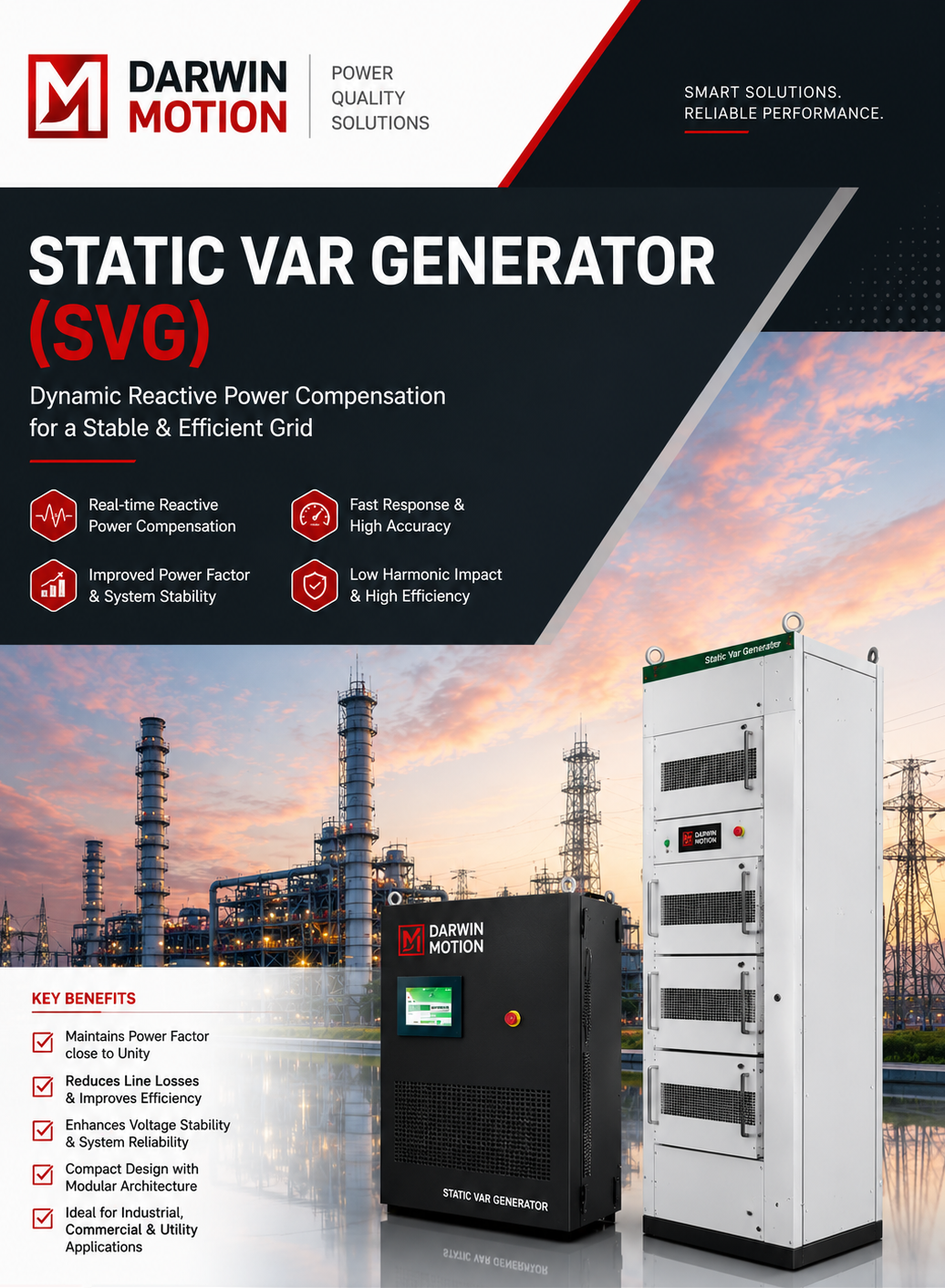
Cement manufacturing is a continuous and energy-intensive process that depends on large electrical machines for crushing, grinding, material handling, ventilation, kiln operation, pumping and other production activities. These systems often operate with motors, Variable Frequency Drives (VFDs), compressors and other electrical loads that can create changing reactive power requirements.
Maintaining an appropriate power factor and stable electrical conditions is therefore an important consideration for cement plant power systems. A SVG for Cement Plant provides a dynamic method of compensating reactive power and supporting voltage stability as plant loads change.
Darwin Motion AC Drive manufacturer offers Static Var Generator technology designed for dynamic reactive power compensation. Its SVG uses power-electronic switching technology and intelligent control to inject or absorb reactive current according to the requirements of the electrical network.
Large induction motors used throughout a cement plant require reactive power for establishing their magnetic fields. Although reactive power does not perform useful mechanical work directly, it influences the current flowing through the electrical distribution system.
When reactive power demand becomes significant, the plant electrical network may experience increased current flow, lower power factor and additional losses in transformers, cables and switchgear.
A Static Var Generator, commonly called SVG or STATCOM at low-voltage applications, is a power-electronic compensation system used to dynamically manage reactive power. Instead of relying on fixed capacitor steps, an SVG continuously calculates the reactive power requirement and provides the required compensating current.
Darwin Motion's SVG uses high-speed IGBT technology and DSP-based control to dynamically inject or absorb reactive power. The manufacturer specifies a response time of approximately 5 milliseconds and continuous, stepless compensation for changing electrical loads.
The electrical demand of a cement plant does not remain constant throughout the production cycle. Different sections of the plant can start, stop or change their operating conditions depending on the production process.
A conventional fixed compensation arrangement may not always respond precisely to these changing requirements. An SVG can continuously adjust its output according to the instantaneous reactive power demand.
An SVG is connected to the plant's electrical distribution system and continuously measures the electrical parameters. Its controller determines the reactive power requirement and commands the power-electronic converter to generate the appropriate compensating current.
When the system requires capacitive compensation, the SVG supplies the required leading reactive current. When inductive compensation is required, it can absorb reactive power as appropriate. This bidirectional capability allows the compensation system to respond to changing operating conditions.
An SVG can dynamically compensate reactive power and help maintain a higher power factor under varying load conditions. Darwin Motion specifies power-factor performance up to 0.99 for its SVG under applicable operating conditions.
Compensating reactive power locally can reduce unnecessary reactive current flowing through portions of the plant electrical distribution network. This can help optimize the utilization of transformers, cables and switchgear.
Lower reactive current can contribute to reducing I²R losses in electrical conductors and distribution equipment. The actual energy-saving potential depends on the existing electrical system, load profile and compensation requirements.
Rapid changes in reactive power demand can influence voltage conditions in an industrial electrical network. Dynamic SVG compensation can support voltage stability by responding rapidly to reactive power variations.
Cement plants operate numerous high-capacity motors. Dynamic reactive power compensation can help maintain suitable electrical conditions for motor-heavy sections of the plant.
Reducing unnecessary reactive current can create additional capacity within existing electrical infrastructure. This can be particularly useful in facilities where transformer and cable loading needs to be managed efficiently.
Unlike stepped capacitor systems, SVG technology provides continuously adjustable compensation rather than switching between predetermined capacitor steps. This enables compensation to follow changing plant requirements more precisely.
Automatic Power Factor Correction (APFC) panels generally use capacitor banks that are switched in steps according to the measured power factor. This approach can work effectively for relatively stable loads, but rapidly changing industrial loads may require more responsive compensation.
An SVG uses power electronics to provide continuous reactive power compensation without conventional capacitor-step switching.
The appropriate SVG installation point depends on the plant's electrical architecture, reactive power profile and location of major loads. Compensation may be considered at major distribution sections or at selected load groups following an electrical-system assessment.
Modern cement plants increasingly use VFDs to control motor speed according to process requirements. VFDs provide valuable control and energy-management capabilities, but the overall electrical system may require additional power-quality measures depending on the drive topology and installation.
An SVG primarily addresses reactive power compensation and power factor requirements. Where harmonic distortion is also a significant concern, a separate Active Harmonic Filter or an appropriately configured power-quality solution may be considered.
Darwin Motion AC Drive manufacturer provides industrial drive and power-quality technologies for applications requiring controlled motor operation and improved electrical performance. Its product portfolio includes AC Drives, Variable Frequency Drives, Static Var Generators and Active Harmonic Filters.
For cement manufacturing facilities, combining suitable motor-control technology with an appropriately engineered reactive power compensation system can provide a coordinated approach to electrical-system management.
An SVG should be selected according to the actual electrical characteristics of the cement plant rather than only the total connected load. A detailed site assessment can help determine the appropriate compensation capacity and installation location.
The exact SVG rating should be selected according to the application. Darwin Motion publishes the following indicative specifications for its SVG platform:
A cement plant's electrical network must support large motors, drives, fans, grinding systems, compressors and other continuously operating equipment. Because reactive power demand can change with production conditions, a fixed compensation arrangement may not always provide the desired response.
A SVG for Cement Plant provides a dynamic approach to reactive power compensation, helping improve power factor, manage reactive current and support voltage stability under changing operating conditions.
With its Static Var Generator technology, industrial automation expertise and power-quality product portfolio, Darwin Motion AC Drive manufacturer offers solutions for cement plants seeking dynamic electrical compensation and improved power-system performance.