
Posted on 2nd Sep 2026
Modern industrial electrical networks are becoming increasingly dynamic. Manufacturing plants, processing facilities, infrastructure projects and commercial installations operate motors, compressors, pumps, HVAC systems, welding equipment, VFDs and other electrical loads that can cause rapid changes in reactive power demand. Managing these variations efficiently is essential for maintaining a stable and reliable electrical system.
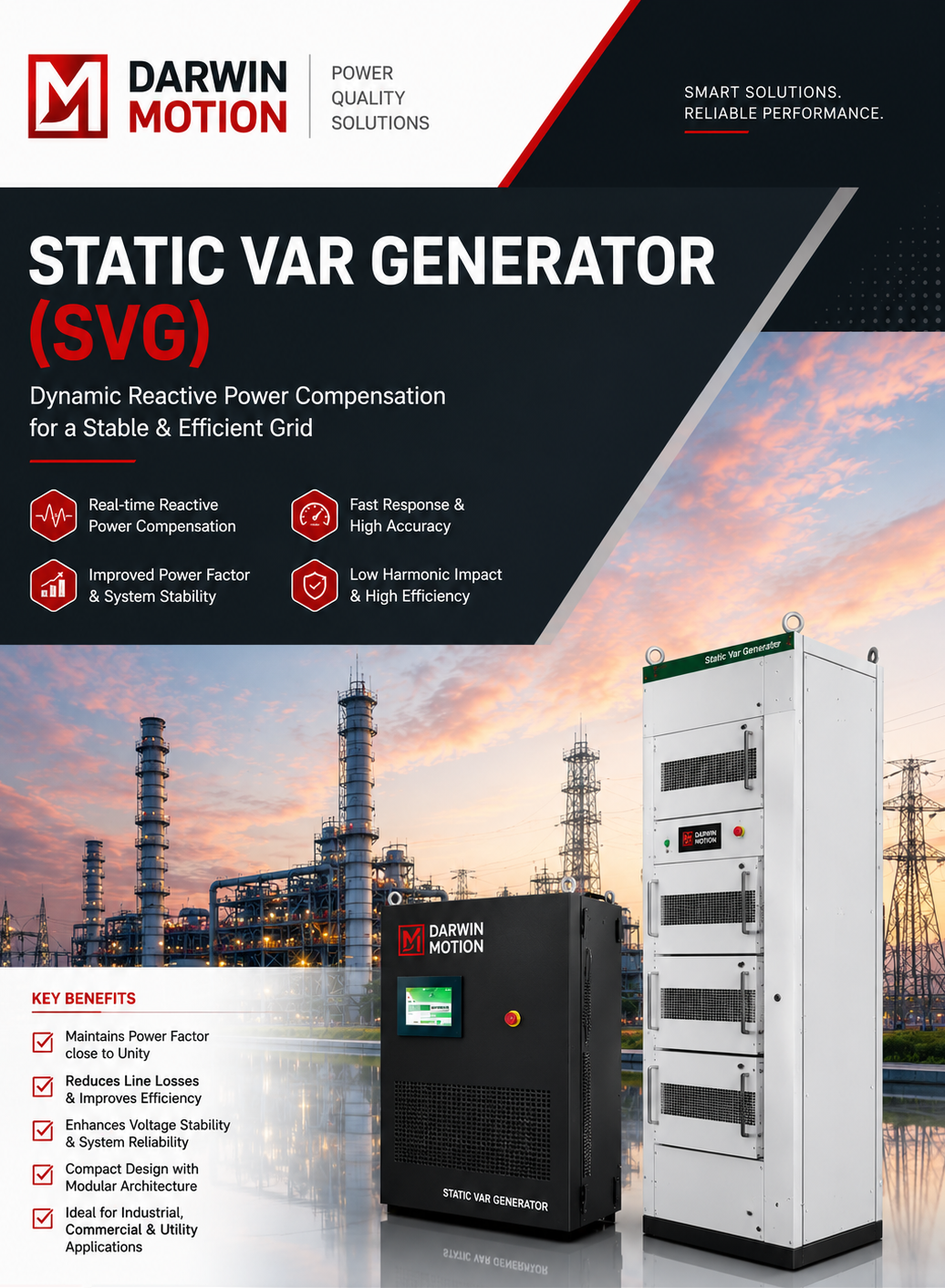
A Static VAR Generator Supplier can provide an advanced solution for applications where conventional power factor correction systems cannot respond quickly enough to changing loads. Darwin Motion, a leading AC Drive manufacturer, offers Static VAR Generator technology designed for real-time reactive power compensation and improved electrical performance.
A Static VAR Generator (SVG) is a power-electronic device used to dynamically manage reactive power in an electrical network. Instead of depending on fixed capacitor steps, an SVG continuously monitors the electrical system and adjusts reactive current according to the actual requirement of the connected load.
Darwin Motion's SVG technology uses high-speed power electronics and digital control to provide dynamic compensation. According to the manufacturer's published specifications, its SVG is designed for capacitive and inductive compensation, voltage stabilization, load balancing and near-unity power factor operation. :contentReference[oaicite:0]{index=0}
Industrial loads rarely remain constant throughout a production cycle. Motors may start and stop, production machinery may change speed, compressors may cycle and welding or other high-demand equipment can create sudden variations in electrical demand.
When reactive power changes rapidly, a conventional stepped capacitor system may not be able to follow the load precisely. An SVG is designed to provide continuous compensation, making it particularly useful for facilities with fluctuating electrical loads.
Automatic Power Factor Correction (APFC) panels traditionally use capacitor banks that are switched in and out according to the measured power factor. While this approach can be effective for relatively stable loads, rapidly changing applications may require a more responsive technology.
Selecting the right SVG solution can help improve several aspects of an industrial electrical distribution system. The actual benefits depend on the existing network, load profile, installation conditions and system design.
An SVG dynamically supplies or absorbs reactive current according to system requirements. This helps maintain a high power factor even when plant loads fluctuate.
Efficient reactive power management can reduce unnecessary reactive current flowing through transformers, cables and distribution equipment.
Rapid reactive power compensation can support voltage stability, particularly in electrical networks experiencing frequent load variations.
Improving power factor can reduce current associated with reactive power. Lower current can help reduce I²R losses in electrical distribution components.
Reducing unnecessary reactive current can help make more effective use of transformer, cable and switchgear capacity.
Unlike fixed-step compensation, SVG technology is designed to continuously track changing reactive power requirements, making it useful for modern automated production environments.
SVG technology can be considered across a broad range of industrial and commercial applications where reactive power changes rapidly or maintaining a high power factor is important.
Manufacturing facilities often operate multiple motors, VFDs, compressors, conveyors and automated machines simultaneously. A dynamic compensation system can help manage the changing reactive power requirements of these loads.
Steel plants and rolling mills can contain large motors and electrically demanding processes. Dynamic reactive power compensation can be an important part of maintaining electrical system performance.
Cement manufacturing involves crushers, mills, conveyors, fans and pumps. SVG solutions can be considered where the electrical system experiences variable reactive power demand.
Textile production uses numerous motors, spinning machines, winding systems, compressors and HVAC equipment. Dynamic power factor correction can support efficient operation of such facilities.
Automated production lines, welding systems, robotics and motor-driven equipment can produce rapidly changing electrical loads. SVG technology can help compensate reactive power dynamically.
Pumping stations, blowers, treatment equipment and variable-speed drives can create changing electrical demand. SVG technology can be integrated into the power distribution system where dynamic reactive power compensation is required.
The operation of an SVG is based on continuous measurement and power-electronic control. The system monitors electrical parameters and determines whether the network requires inductive or capacitive reactive power compensation.
Darwin Motion states that its SVG uses high-speed IGBT technology and intelligent DSP control, with a published response time of approximately 5 ms. :contentReference[oaicite:1]{index=1}
Variable Frequency Drives provide significant advantages in motor-speed control and energy management, but facilities with many power-electronic loads must also consider the overall characteristics of their electrical network.
This is where the combination of advanced AC Drives and power-quality equipment becomes valuable. As an AC Drive manufacturer, Darwin Motion understands the requirements of motor-driven industrial systems and provides power-quality technologies alongside its drive solutions.
A suitable SVG installation can help address reactive power requirements without compromising the variable-speed operation of VFD-driven machinery.
Choosing a Static VAR Generator should not be based solely on the compensation capacity of the equipment. The supplier should understand the complete electrical environment and application requirements.
Darwin Motion is an industrial automation company specializing in Variable Frequency Drives, Servo Drives and related power-electronics solutions. The company provides solutions for industries including steel, textile, packaging, automotive and other industrial applications. :contentReference[oaicite:2]{index=2}
Along with AC Drive technology, Darwin Motion offers a power-quality portfolio that includes Static VAR Generators, Active Harmonic Filters, Dynamic Voltage Restorers and other power-quality solutions. :contentReference[oaicite:3]{index=3}
Energy efficiency is not limited to reducing the active power consumed by machines. The way electrical power flows through an industrial distribution system also affects equipment utilization, losses and overall system performance.
By managing reactive power dynamically, an SVG can help reduce unnecessary current and support a better power factor. This can contribute to more efficient utilization of electrical infrastructure and improved operating conditions.
A Static VAR Generator and an Active Harmonic Filter are related power-quality technologies, but they address different primary requirements. SVG technology primarily focuses on dynamic reactive power compensation and power factor management, while an Active Harmonic Filter is primarily used to mitigate harmonic currents.
Some modern power-quality systems can provide multiple compensation functions. However, the appropriate solution should be selected after evaluating the actual electrical characteristics of the installation.
Every industrial electrical network has a different load profile. Therefore, the correct SVG capacity and installation configuration should be determined using actual system data rather than a generic rating.
As industrial electrical systems become more automated and load profiles become increasingly dynamic, conventional fixed-step power factor correction may not always provide the required level of responsiveness. A Static VAR Generator offers a modern approach to managing reactive power continuously and dynamically.
From manufacturing plants and steel mills to textile facilities, water treatment plants, commercial buildings and infrastructure projects, SVG technology can help improve power factor, support voltage stability and reduce unnecessary reactive current.
If you are looking for a reliable Static VAR Generator Supplier, Darwin Motion combines power-electronics expertise with its experience as an AC Drive manufacturer to provide advanced solutions for industrial power-quality requirements.
A Static VAR Generator is a power-electronic device that dynamically supplies or absorbs reactive power to improve power factor and support voltage stability.
The primary advantage is dynamic, stepless compensation. SVG can respond to changing reactive power demand without relying on conventional fixed capacitor switching steps.
Yes. SVG can be used in electrical systems containing VFDs, provided the solution is correctly engineered for the site's electrical characteristics and reactive power requirements.
Yes. Dynamic reactive power compensation can help maintain a high power factor under changing load conditions. Darwin Motion publishes a power-factor capability of up to 0.99 for its SVG solution. :contentReference[oaicite:4]{index=4}