
Posted on 14th Aug 2026
Modern industrial electrical systems are expected to deliver stable voltage, dependable power quality, and efficient operation even when connected loads change rapidly. Large motors, variable-speed drives, welding equipment, furnaces, compressors, and other industrial loads can create fluctuating reactive power requirements. If these variations are not properly managed, they may result in voltage fluctuations, poor power factor, increased electrical losses, and reduced system performance.
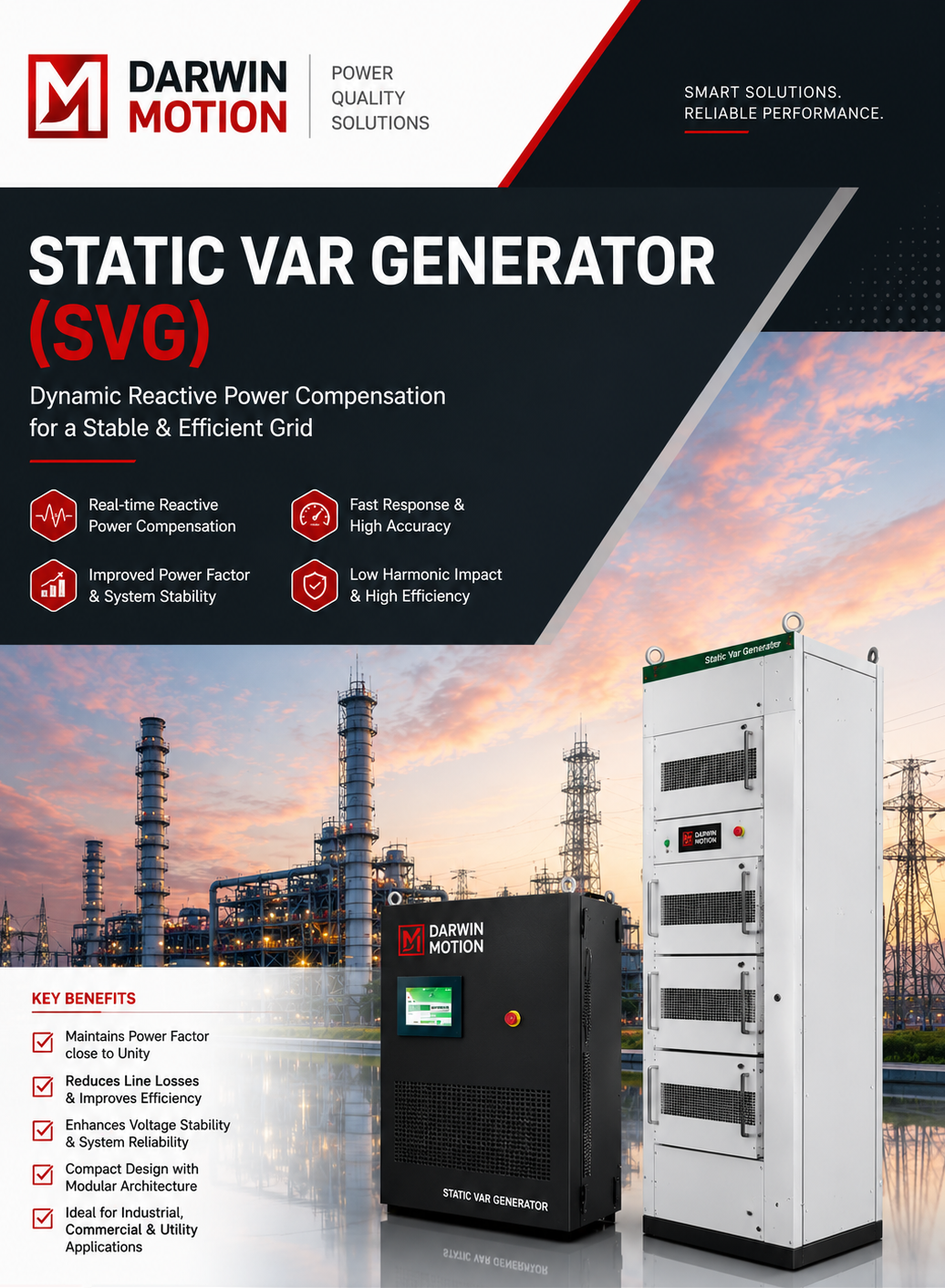
A Static VAR Compensator (SVC) is a power-quality and reactive-power compensation system designed to dynamically regulate reactive power and support voltage stability. It can respond to changing electrical conditions much faster than conventional mechanically switched compensation equipment, making it suitable for demanding industrial and power-system applications.
A Static VAR Compensator is a shunt-connected electrical compensation system that regulates reactive power by controlling capacitive and inductive components. Its primary purpose is to help maintain a desired voltage level while managing the reactive power requirements of an electrical network.
Unlike traditional capacitor banks that generally operate in fixed or stepped stages, an SVC can provide dynamic compensation. Its control system continuously monitors electrical conditions and adjusts the compensation according to the requirements of the connected system.
Typical SVC configurations can incorporate thyristor-controlled reactors, thyristor-switched capacitors, and harmonic-filter branches. The exact arrangement depends on the voltage level, application, reactive-power requirement, and power-quality objectives.
Reactive power is essential for the operation of many AC electrical devices, particularly motors and transformers. However, excessive or rapidly changing reactive power demand can place additional demands on electrical distribution systems.
When reactive power is not adequately managed, facilities may experience voltage variations and lower power factor. In applications with rapidly changing loads, these effects can become particularly noticeable and may influence production equipment and overall electrical-system performance.
The operation of an SVC is based on controlled shunt compensation. The system measures electrical parameters such as voltage and reactive power and uses a control system to determine the required compensation.
When additional capacitive reactive power is required, the SVC can increase capacitive support. When the system requires reactive-power absorption, inductive compensation can be applied. This dynamic response allows the SVC to help maintain voltage within the desired operating range.
A Thyristor-Controlled Reactor (TCR) uses thyristor-based control to regulate the current flowing through a reactor. By controlling the reactor's conduction angle, the system can continuously adjust its inductive reactive-power contribution.
A Thyristor-Switched Capacitor (TSC) provides capacitive reactive power when required. Capacitor branches can be switched according to the compensation demand, contributing to dynamic reactive-power management.
Harmonic-filter branches may form part of an SVC installation. Besides contributing to the overall compensation arrangement, appropriately designed filter branches can help address harmonic components associated with nonlinear loads and power-electronic equipment.
The control system monitors network conditions and coordinates the compensation branches. Protection functions are also essential to help safeguard the equipment during abnormal electrical conditions.
One of the principal advantages of SVC technology is its ability to respond rapidly to voltage changes. Dynamic reactive-power control can help stabilize voltage when the electrical load varies.
Industrial loads can require substantial reactive power, resulting in a lower power factor. By supplying or absorbing reactive power as required, an SVC can help improve the power factor of an electrical installation.
Rapidly changing industrial loads can produce voltage variations. Dynamic compensation helps counteract these variations and can provide a more stable voltage profile.
Effective reactive-power management can help reduce unnecessary reactive current in the electrical network. This may allow existing electrical infrastructure to be utilized more effectively.
Stable electrical conditions are important for automated manufacturing processes. Improved voltage stability and power quality can support the reliable operation of motors, drives, control systems, and other production equipment.
Conventional mechanically switched compensation can involve switching delays and mechanical wear. An SVC uses power-electronic control to respond dynamically to changing reactive-power requirements. SVC technology has long been used for fast voltage control in both industrial and transmission applications.
Conventional capacitor banks remain useful for applications where reactive-power requirements are relatively predictable. However, they may not provide the same level of dynamic response as an electronically controlled compensation system.
An SVC is particularly valuable when the reactive-power requirement changes frequently. Instead of relying exclusively on fixed compensation steps, the SVC can adjust its operating state in response to changing electrical conditions.
SVC technology can be applied wherever rapid changes in reactive power or voltage create challenges for the electrical network. Industrial facilities with high-power or fluctuating loads can particularly benefit from dynamic compensation.
Electric arc furnaces and related metal-processing equipment can produce rapidly varying electrical loads. SVC systems can be used for voltage support and power-quality improvement in such environments. Industrial SVC installations have also been used to mitigate flicker associated with electric arc furnaces.
Large manufacturing facilities may operate numerous motors, drives, welding systems, compressors, and automated machines simultaneously. Dynamic reactive-power compensation can help maintain electrical stability as production loads change.
Mining facilities often have large motors and heavy electrical equipment operating under variable conditions. Reactive-power compensation can support voltage stability and improve the utilization of electrical infrastructure.
Large pumping installations can have substantial motor loads. SVC solutions can be considered where fluctuating reactive-power demand creates voltage-management challenges.
SVCs are also used in transmission and distribution networks for voltage support and system stability. For example, SVC installations have been deployed on high-voltage networks to maintain voltage and increase transmission-system stability.
Power quality is an important consideration for facilities that depend on sensitive automation, process-control equipment, and high-performance electrical machinery. Voltage instability can affect equipment operation and may contribute to production interruptions.
An SVC can help improve the electrical environment by dynamically controlling reactive power. In suitable applications, this can support voltage stability, reduce the effects of fluctuating loads, and contribute to improved power-system performance.
Selecting a Static VAR Compensator should be based on an engineering assessment of the electrical system. The compensation rating and configuration need to correspond to the actual operating characteristics of the installation.
An SVC should not be selected simply on the basis of the connected load capacity. Electrical measurements and system studies can help determine the required reactive-power range and identify voltage and power-quality problems.
A complete assessment may include load-flow analysis, power-factor measurements, harmonic measurements, voltage studies, and evaluation of the facility's operating profile. Proper engineering helps ensure that the compensation equipment is appropriately sized for both normal and changing operating conditions.
Industrial automation increasingly relies on variable-speed drives, robotic machinery, digitally controlled production equipment, and high-capacity motor systems. These technologies can improve productivity and energy management, but they can also create more complex electrical operating conditions.
Combining efficient AC drive technology with appropriate reactive-power and power-quality management can help create a more robust industrial electrical infrastructure. This is especially important in facilities where production equipment operates continuously or where sudden load changes are common.
Darwin Motion is an AC Drive manufacturer serving industrial motor-control and automation requirements. Its drive technology is intended for applications where dependable motor control, energy efficiency, and reliable industrial operation are important.
As an AC Drive manufacturer, Darwin Motion focuses on technologies associated with industrial drive and power-control applications. Its product portfolio includes AC drive solutions and power-quality-related technologies designed for industrial environments.
For facilities evaluating reactive-power compensation, the Static VAR Compensator can be considered as part of a broader electrical-system strategy. The appropriate solution should be determined according to the facility's voltage requirements, load behavior, reactive-power profile, and power-quality objectives.
Regular maintenance is important for maintaining the reliability and performance of a Static VAR Compensator. Inspection requirements depend on the system design, operating environment, and manufacturer recommendations.
A Static VAR Compensator provides a dynamic approach to reactive-power management and voltage regulation. By responding to changing electrical conditions, SVC technology can help industrial and power-system operators address voltage fluctuations, improve power factor, support electrical capacity, and enhance overall power quality.
The right SVC configuration depends on the electrical network, load characteristics, required compensation range, voltage level, and application objectives. For organizations working with industrial motors, automation, and variable-speed drive systems, partnering with an experienced Darwin Motion AC Drive manufacturer can be an important part of developing an effective electrical power-management strategy.