
Posted on 18th Aug 2026
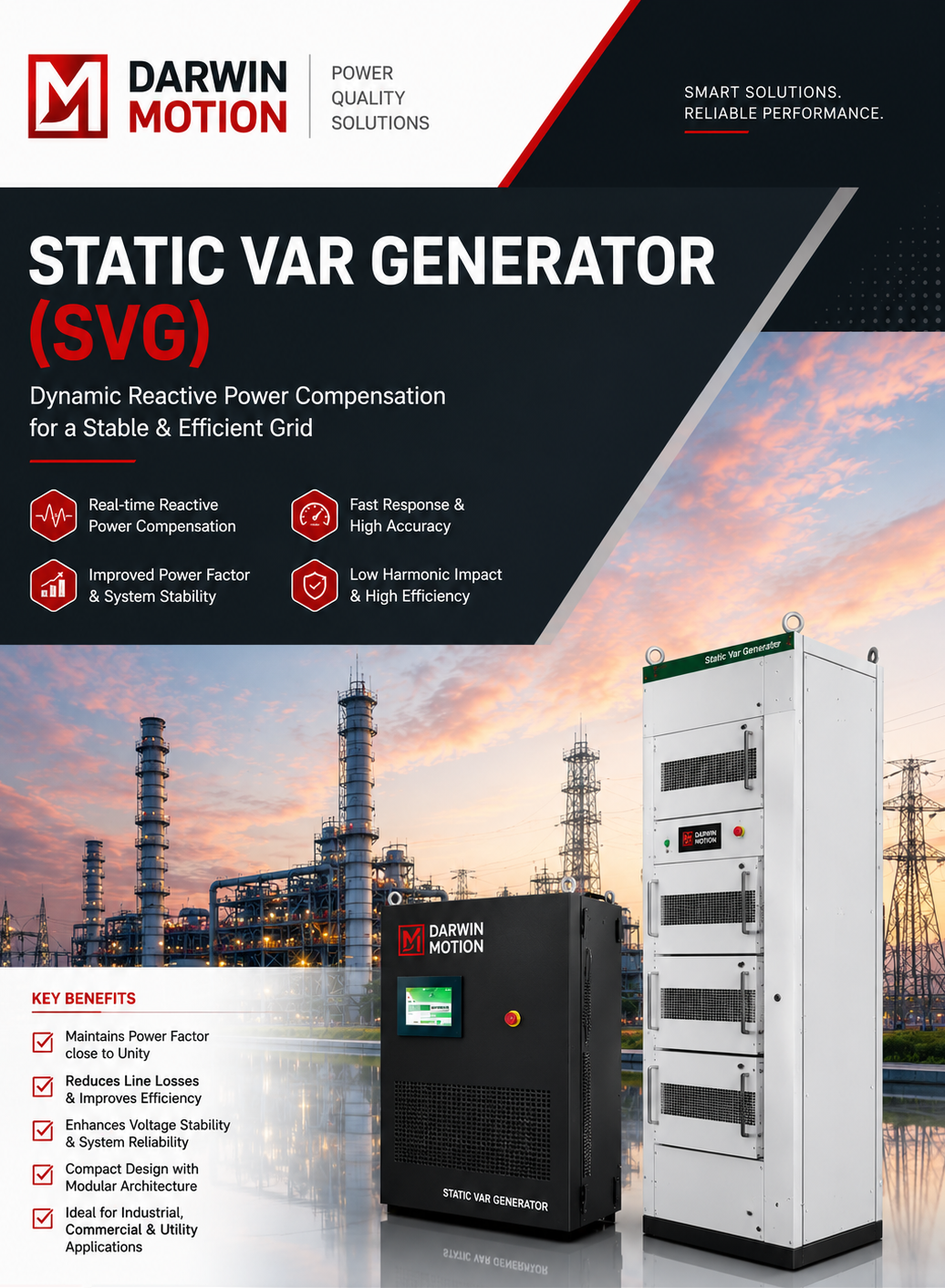
Modern industrial electrical networks often operate with large motors, transformers, furnaces, compressors, pumps, and other fluctuating loads. These loads can create changing reactive power requirements, leading to poor power factor, voltage fluctuations, and increased stress on the electrical distribution system. A Static VAR Compensator provides a dynamic approach to managing reactive power and maintaining better electrical system performance.
For industries looking to improve power quality and optimize electrical infrastructure, Darwin Motion AC Drive Manufacturer offers advanced power-electronic solutions designed for demanding industrial environments. Darwin Motion focuses on industrial automation, drives, energy efficiency, and technologies that help businesses improve equipment performance and resource utilization.
A Static VAR Compensator, commonly referred to as an SVC, is a power-electronic system used to regulate reactive power within an electrical network. Its primary purpose is to dynamically supply or absorb reactive power according to changing load requirements.
Instead of relying only on fixed capacitor banks, an SVC can respond to variations in electrical demand. This makes it particularly useful in industrial facilities where loads change frequently and voltage stability is an important operational requirement.
Reactive power is an essential component of AC electrical systems. Motors, transformers, and other inductive equipment require reactive power to establish magnetic fields. Although reactive power does not perform useful mechanical work in the same way as active power, it has a significant impact on current flow, voltage regulation, and power factor.
When reactive power demand becomes excessive, the electrical system may experience higher current levels and additional losses. A properly designed compensation system can help manage these conditions.
A Static VAR Compensator uses power-electronic switching technology to control reactive power. It continuously evaluates the electrical conditions and adjusts compensation according to the requirements of the connected load.
This dynamic operation allows an SVC to respond much more effectively to rapidly changing load conditions than a simple fixed compensation arrangement.
Industrial plants can have significant reactive power requirements because of the large number of inductive machines used in production. Motors, pumps, compressors, fans, welding equipment, and other machinery may operate at different loads throughout the production cycle.
These variations can make maintaining a stable electrical network more challenging. A Static VAR Compensator can help the facility manage reactive power dynamically and improve the overall utilization of its electrical infrastructure.
Traditional capacitor banks are commonly used for reactive power compensation, but they typically operate in fixed or stepped stages. This approach can be suitable for relatively stable loads, but rapidly changing industrial processes may require a more responsive solution.
A Static VAR Compensator offers dynamic control. Instead of simply switching fixed amounts of capacitance, the compensation level can be continuously adjusted according to the electrical requirements.
Static VAR compensation can be valuable in industrial environments where electrical loads fluctuate or where reactive power management is a significant concern.
Large manufacturing facilities often operate numerous motors and automated machines simultaneously. Dynamic reactive power compensation can help maintain better electrical conditions as production loads change.
Steel plants and metal-processing facilities can have large and rapidly varying electrical loads. Reactive power compensation can support voltage regulation and improve the performance of the electrical distribution system.
Industrial welding equipment can create fluctuating electrical demand. A dynamic compensation solution can help manage reactive power variations associated with such loads.
Mining operations frequently use large motors, conveyors, pumps, crushers, and other heavy machinery. Reactive power management can become an important part of maintaining reliable electrical operation.
Water treatment plants, pumping stations, large HVAC installations, and other infrastructure facilities may also benefit from dynamic reactive power compensation when their electrical loads vary significantly.
Power factor represents how effectively an electrical system uses supplied apparent power. A low power factor means that more current may be required to deliver a given amount of useful active power.
Reactive power compensation can reduce the reactive component of current drawn from the upstream electrical network. As a result, an appropriately engineered compensation system can improve power factor and help reduce avoidable electrical losses.
Voltage fluctuations can affect sensitive industrial equipment and production processes. Large motors starting or rapidly changing loads can create variations in voltage within an electrical network.
Because an SVC can dynamically control reactive power, it can provide voltage-support functionality in suitable applications. This makes it an important technology for facilities where stable voltage is essential for reliable production.
Every industrial electrical system has different characteristics. Selecting a Static VAR Compensator should therefore involve an assessment of the actual electrical network rather than choosing a system based only on connected load capacity.
Darwin Motion AC Drive Manufacturer provides industrial automation and motor-control solutions for applications across manufacturing, water and pumping, packaging, material handling, food and beverage, building automation, and other industrial sectors. The company's portfolio includes AC Drives and related drive technologies designed for industrial applications.
Darwin Motion emphasizes research and development in automation technology and provides solutions intended to improve energy efficiency, asset reliability, productivity, safety, and performance.
A Static VAR Compensator should be considered as part of the complete electrical-system design. The compensation system may need to coordinate with transformers, switchgear, VFDs, motors, capacitor systems, harmonic filters, and other power-quality equipment.
A detailed site assessment can identify the primary source of reactive power demand and determine whether dynamic VAR compensation, harmonic mitigation, conventional capacitor banks, or a combination of technologies is most appropriate.
A Static VAR Compensator is a valuable technology for industrial facilities that require dynamic reactive power management, improved power factor, and better voltage support. Its ability to respond to changing electrical conditions makes it particularly suitable for applications with fluctuating loads.
By combining appropriate power-quality engineering with reliable industrial automation technologies, businesses can build electrical systems that operate more efficiently and consistently. Darwin Motion AC Drive Manufacturer brings experience in AC Drives, industrial automation, and energy-efficiency-focused solutions, making it a relevant technology partner for modern industrial applications.
For the best results, SVC sizing and system integration should be based on an engineering assessment of the site's electrical network, load characteristics, voltage profile, and power-quality requirements.
The main purpose of an SVC is to dynamically manage reactive power in an electrical network. It can help improve power factor and provide voltage support under suitable operating conditions.
Yes. By compensating for reactive power demand, a properly sized SVC can improve the power factor of an electrical system.
SVCs can be used in manufacturing plants, steel and metal-processing facilities, mining operations, welding applications, pumping systems, infrastructure facilities, and other installations with significant or fluctuating reactive power requirements.
No. Conventional capacitor banks generally provide fixed or stepped reactive compensation, while an SVC is designed for dynamic reactive power control.
Darwin Motion develops industrial automation and drive solutions and serves multiple industrial sectors with a focus on efficiency, reliability, productivity, and performance.
Businesses seeking improved reactive power management can explore Darwin Motion's Static VAR Compensator solution and evaluate the appropriate configuration based on their electrical-system requirements.