

Posted on 8th Sep 2026
Electrical power systems are becoming increasingly dynamic. Modern factories operate motors, pumps, compressors, Variable Frequency Drives (VFDs), HVAC systems, welding equipment, CNC machines and automated production lines, often with constantly changing load conditions.
These changing loads can cause fluctuations in reactive power demand and make it difficult for conventional power factor correction systems to maintain an optimum power factor. A smarter approach is required when the electrical load does not remain constant throughout the production cycle.
Smart Power Factor Correction provides a modern approach to managing reactive power by continuously monitoring the electrical network and dynamically adjusting compensation according to the actual load requirement.
Power factor represents how effectively an electrical system uses the supplied apparent power. When an industrial facility operates large inductive loads, the current and voltage waveforms can develop a phase difference, resulting in reactive power consumption and a lower power factor.
A poor power factor means that the electrical infrastructure may need to carry more current to deliver the same amount of useful active power. This can increase losses in transformers, cables and switchgear and may also reduce the usable capacity of electrical distribution equipment.
Conventional Automatic Power Factor Correction (APFC) systems generally use capacitor banks that are switched in stages according to the measured reactive power requirement. This approach can work effectively where the electrical load is relatively predictable and stable.
However, modern manufacturing facilities can experience frequent and rapid changes in reactive power demand. When the load changes faster than the capacitor stages can respond, the system may experience under-correction or over-correction.
This is where power-electronics-based reactive power compensation can provide an alternative approach for demanding applications.
Smart Power Factor Correction uses intelligent electronic control to continuously identify reactive power requirements and provide the required compensation dynamically.
Instead of relying exclusively on fixed capacitor steps, a Static Var Generator (SVG) can generate or absorb reactive current according to the instantaneous condition of the electrical network.
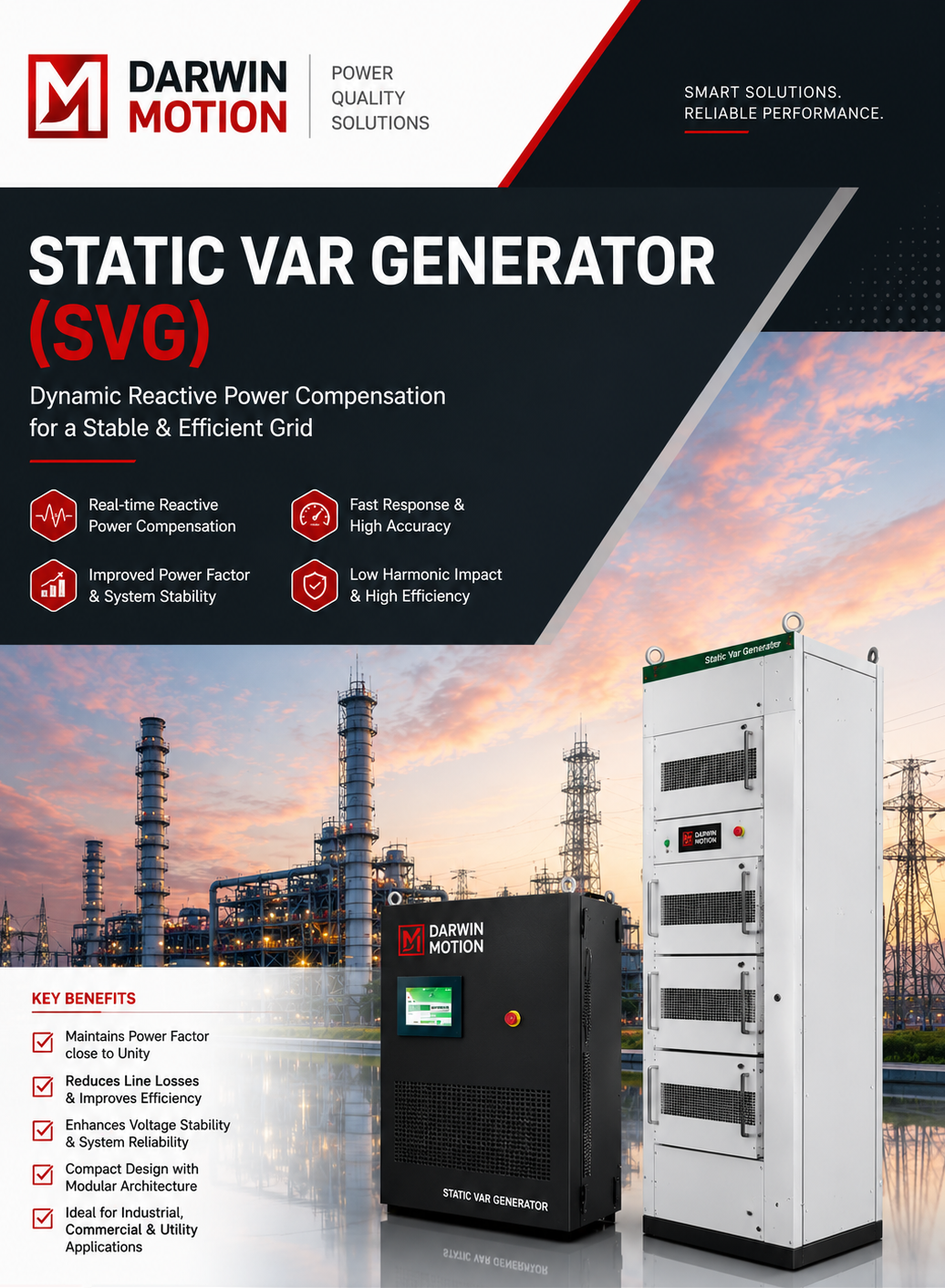
Darwin Motion's Static Var Generator uses high-speed IGBT technology and intelligent DSP control for real-time reactive power compensation. According to the manufacturer's published specifications, the system can respond within milliseconds and provide continuous, stepless compensation. :contentReference[oaicite:1]{index=1}
A Static Var Generator is a power-electronic device designed primarily for dynamic reactive power compensation. It continuously monitors the electrical system and determines whether inductive or capacitive reactive compensation is required.
The operating process can be understood through four basic stages:
This continuous control allows the compensation system to follow changing industrial loads rather than depending solely on predefined capacitor stages.
Maintaining a high power factor allows the electrical system to utilize supplied power more effectively. Darwin Motion's published SVG specifications indicate power-factor performance of up to 0.99, subject to system conditions and application design. :contentReference[oaicite:2]{index=2}
Industrial loads can change significantly during production. Smart compensation responds to these changes by continuously adjusting reactive current instead of waiting for conventional capacitor stages to switch.
Improving power factor can reduce unnecessary reactive current flowing through electrical distribution equipment. Lower current can help reduce resistive I²R losses in cables, transformers and switchgear.
Poor power factor increases apparent power demand. Improving the power factor can reduce reactive current and help make better use of the available capacity of transformers and distribution equipment.
Rapid variations in reactive power can influence voltage conditions within an electrical network. Dynamic reactive compensation can help support a more stable voltage profile during changing load conditions.
Depending on the applicable electricity tariff and utility requirements, maintaining an appropriate power factor can help industrial consumers reduce costs associated with poor power factor.
The major difference between a conventional APFC system and an SVG-based solution is the method and speed of compensation.
| Parameter | SVG-Based Correction | Conventional APFC |
|---|---|---|
| Compensation | Continuous and stepless | Step-based |
| Response | Millisecond-level | Dependent on switching and control cycle |
| Switching Contactors | Not required for compensation stages | Commonly used |
| Dynamic Loads | Highly suitable | Can be challenging |
| Correction Accuracy | Continuous | Dependent on available capacitor steps |
| Maintenance | Low-maintenance power-electronic system | Capacitor and switching components require maintenance |
Dynamic power factor correction is particularly valuable in facilities where reactive power demand changes frequently. The technology can be applied across a wide range of industrial and commercial environments.
VFDs have become an important part of modern motor-control systems because they provide speed control and can improve process efficiency. Industrial facilities may operate hundreds of motors controlled through VFDs, depending on the application.
The overall electrical network should therefore be evaluated as a complete system. Reactive power requirements, harmonic distortion, load profile, transformer capacity and existing compensation equipment should be considered before selecting a power-quality solution.
Darwin Motion AC Drive Manufacturer develops industrial automation and power-quality technologies for applications where electrical efficiency, reliability and dynamic load management are important.
Beyond AC Drives and VFD solutions, Darwin Motion offers Static Var Generator technology for dynamic reactive power compensation. Its SVG platform is designed to address changing reactive power requirements through high-speed electronic control. :contentReference[oaicite:3]{index=3}
Power factor correction does not mean that an industrial facility will automatically consume less active energy for every process. Its primary purpose is to manage reactive power and reduce unnecessary current demand in the electrical network.
By reducing reactive current, a properly engineered compensation system can reduce losses in electrical distribution equipment and improve the utilization of existing electrical infrastructure.
The result can be a more efficient electrical network with improved capacity utilization and better operating conditions for connected equipment.
Industrial facilities are becoming increasingly automated and flexible. Production equipment may start and stop according to production schedules, process requirements and automation commands.
As a result, the electrical load profile can change throughout the day. A power factor correction system that can continuously adapt to these changes provides a more flexible approach than a fixed compensation arrangement.
Smart reactive power management can therefore become an important component of modern power-quality strategies, especially in facilities with highly variable electrical loads.
The correct compensation technology should be selected after understanding the actual characteristics of the electrical installation rather than relying only on the total connected load.
Power factor management is no longer limited to switching capacitor banks on and off. With modern industrial loads becoming more dynamic, facilities need compensation technologies that can respond to electrical conditions in real time.
Smart Power Factor Correction using Static Var Generator technology provides continuous reactive power compensation and can help industrial facilities maintain a healthier power factor, reduce unnecessary reactive current, improve voltage stability and make better use of electrical infrastructure.
As a Darwin Motion AC Drive Manufacturer, Darwin Motion combines expertise in industrial motor control and power-quality technologies to provide solutions for modern electrical systems. Its Static Var Generator is designed for applications requiring dynamic and precise reactive power compensation. :contentReference[oaicite:4]{index=4}
Smart Power Factor Correction is a dynamic approach to managing reactive power in which an electronic compensation system continuously monitors electrical conditions and adjusts reactive current according to the actual load requirement.
A Static Var Generator, or SVG, is a power-electronic device that dynamically injects or absorbs reactive current to compensate for changing reactive power demand and improve power factor.
An APFC panel generally uses switched capacitor stages, whereas an SVG provides continuous, stepless electronic reactive power compensation. This makes SVG technology particularly useful for rapidly changing loads. :contentReference[oaicite:5]{index=5}
SVG technology can be used for dynamic reactive power compensation in facilities containing VFDs and other industrial loads. The complete electrical system should be assessed to determine the appropriate power-quality solution.
Improving power factor can reduce unnecessary reactive current in the electrical distribution system, which can help reduce I²R losses in transformers, cables and switchgear.
Darwin Motion AC Drive Manufacturer provides industrial power-quality solutions including Static Var Generator technology, with features such as dynamic compensation, DSP control, high-speed IGBT technology, load balancing and modular expansion. :contentReference[oaicite:6]{index=6}