

Posted on 14th Sep 2026
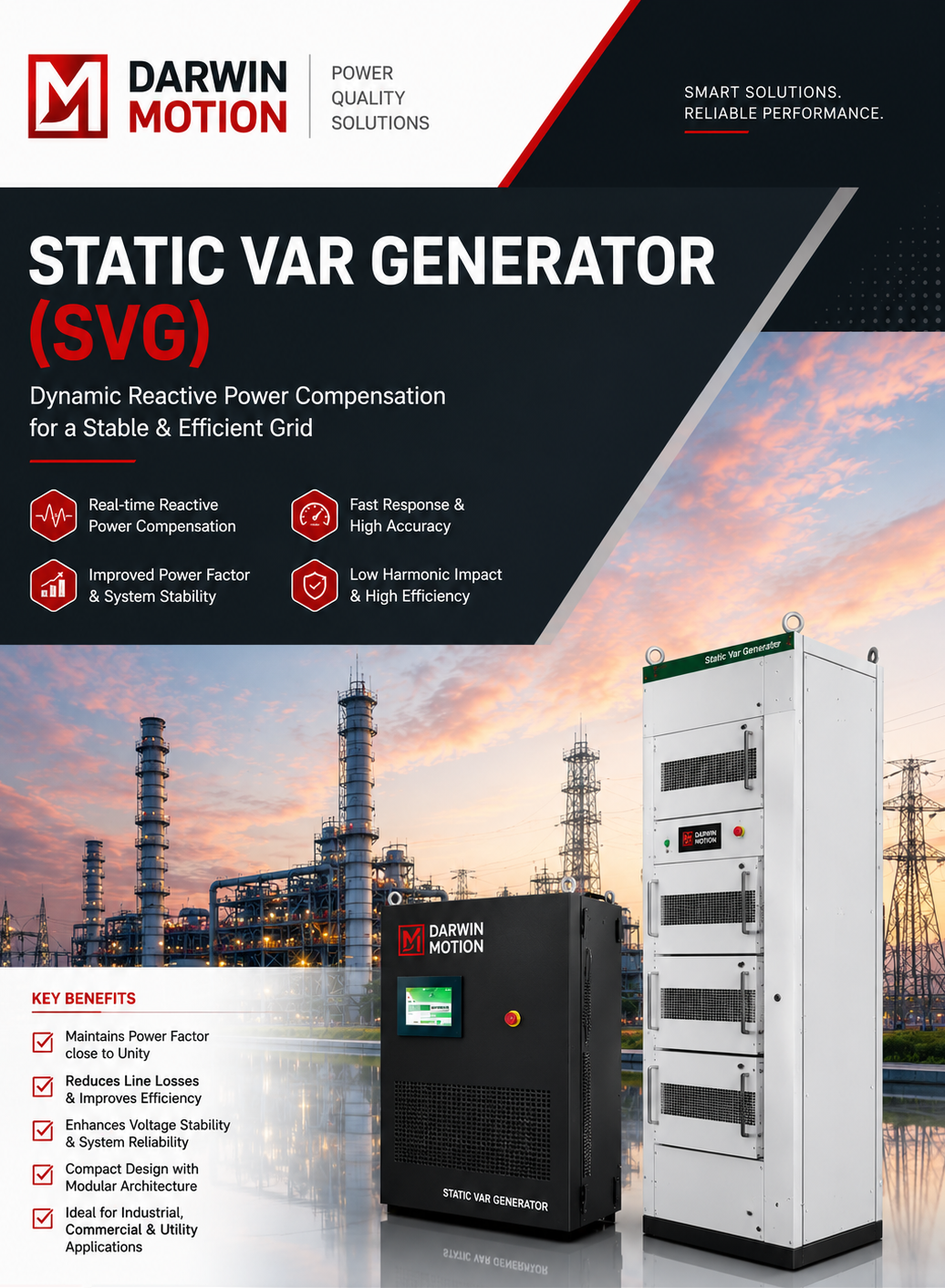
Modern electrical systems are becoming increasingly dynamic. Industrial facilities operate motors, variable frequency drives, compressors, pumps, welding machines, HVAC equipment and other power-electronic loads that continuously change their reactive power requirements. These variations can make conventional power factor correction difficult to maintain.
A Reactive Power Controller provides an intelligent approach to monitoring and managing reactive power demand. By continuously assessing electrical conditions and controlling reactive current compensation, modern systems can maintain a healthier power factor and improve the utilization of electrical infrastructure.
Darwin Motion AC Drive Manufacturer offers advanced power-quality technologies, including Static VAR Generator solutions designed for dynamic reactive power compensation in industrial and commercial electrical networks.
A Reactive Power Controller is a control and compensation solution that monitors the reactive power requirement of an electrical system and manages compensation according to changing load conditions.
The primary objective is to reduce unnecessary reactive current flowing through the electrical network and maintain the desired power factor. In applications with rapidly changing loads, a dynamic controller can provide a more responsive solution than conventional fixed-step correction systems.
Electrical power systems contain three important power components: active power, reactive power and apparent power. Active power performs useful work, while reactive power supports the magnetic and electric fields required by inductive and capacitive equipment.
Although reactive power is necessary for many electrical devices, excessive reactive current increases the apparent power demand of the installation. This can result in higher current flow through transformers, cables and switchgear.
Poor power factor can increase current demand without increasing useful active power. For large industrial installations, this can affect electrical-system capacity, losses and operating costs.
A modern dynamic compensation system continuously measures electrical parameters at the selected point in the network. The controller evaluates the reactive power requirement and determines the amount and direction of compensation required.
This operating principle makes dynamic reactive power compensation particularly useful for facilities where load demand changes frequently throughout the production cycle.
A Static VAR Generator (SVG) is a power-electronic solution capable of providing dynamic reactive power compensation. Unlike conventional capacitor banks that operate through fixed switching steps, an SVG can continuously adjust compensation according to the instantaneous requirements of the electrical system.
Darwin Motion's SVG technology uses high-speed power electronics and intelligent digital control to inject or absorb reactive current. The company's published specifications include system voltage options from 208V to 690V AC, compensation capacities from 30A to 600A and response times of approximately 5 milliseconds, depending on configuration. :contentReference[oaicite:0]{index=0}
Conventional automatic power factor correction panels generally use capacitor stages that are switched according to the measured power factor. This approach can work well with relatively stable loads, but rapidly changing loads may require a more dynamic method of compensation.
An SVG-based Reactive Power Controller provides continuous and stepless compensation, making it suitable for applications where reactive demand can change rapidly. Darwin Motion describes its SVG as capable of both inductive and capacitive compensation, with automatic load detection and voltage-stabilization functionality. :contentReference[oaicite:1]{index=1}
Dynamic reactive power compensation helps bring the electrical system closer to its desired power-factor level by supplying the reactive current required by the load.
Lower unnecessary reactive current can reduce current-related losses in transformers, cables and switchgear. Darwin Motion identifies reduction of I²R losses as one of the potential benefits of its SVG technology. :contentReference[oaicite:2]{index=2}
When reactive current is controlled, electrical infrastructure can be utilized more effectively. Reducing unnecessary apparent-power demand can provide additional operating capacity within appropriately designed systems.
Industrial loads can change rapidly when machines start, stop or change operating conditions. A dynamic controller can respond to these changes much faster than traditional stepped correction approaches.
Reactive power has an important relationship with voltage performance in electrical networks. Dynamic compensation can support voltage stability, particularly in systems experiencing significant load variations.
Fixed capacitor systems can potentially result in leading power factor when load conditions change. Dynamic compensation allows the amount and direction of reactive current to be adjusted according to actual system requirements.
Reactive power controllers are particularly valuable in facilities where inductive loads, power electronics and rapidly changing production processes create variable reactive-power requirements.
Darwin Motion lists manufacturing, automotive, steel, cement, textile, pharmaceutical, water treatment, renewable energy, data centers, EV charging infrastructure and several other sectors among applications for its SVG technology. :contentReference[oaicite:3]{index=3}
Variable-load applications present a particular challenge for conventional power-factor correction. A factory may have periods of high motor loading followed by lower-load conditions, while welding equipment and other intermittent machines can create rapid changes in reactive demand.
In such environments, continuously adjustable compensation can help maintain the required power-factor performance without relying exclusively on large fixed capacitor stages.
Reactive power itself does not perform the useful mechanical work delivered by active power, but reactive current contributes to the current flowing through the electrical distribution system. Controlling unnecessary reactive current can therefore contribute to better utilization of electrical infrastructure.
A well-engineered compensation system can help reduce avoidable losses and improve the operating conditions of transformers, cables and distribution equipment. The actual energy-saving benefit depends on the existing power factor, load profile, electrical-network characteristics and compensation strategy.
Darwin Motion AC Drive Manufacturer combines expertise in AC drives, variable frequency drives and modern power-quality technologies. Its portfolio includes Static VAR Generators, Active Harmonic Filters, Unified Power Quality Controllers and other electrical power-quality solutions. :contentReference[oaicite:4]{index=4}
Darwin Motion states that its SVG can provide power factor up to 0.99 under dynamic load conditions, with a published response time of 5 ms. Actual performance depends on system configuration and application conditions. :contentReference[oaicite:5]{index=5}
Choosing a reactive power compensation system should begin with an assessment of the electrical installation. The required compensation capacity should not be selected solely from the total connected load.
A proper load study helps determine whether the installation requires conventional power-factor correction, dynamic SVG compensation, harmonic filtering, or a combination of power-quality technologies. For complex industrial systems, measurements at the point of common coupling can provide valuable information for equipment sizing and system design.
The transition toward automated manufacturing, variable-speed motors, renewable-energy systems and digitally controlled equipment is making electrical loads more dynamic. Power-factor correction therefore needs to evolve from simple fixed compensation toward intelligent and continuously adjustable power management.
A modern Reactive Power Controller based on SVG technology can provide real-time compensation, helping industries manage changing reactive-power requirements while improving power-system utilization.
Reactive power management is an important part of maintaining a well-performing electrical distribution system. For facilities with fluctuating loads, conventional stepped capacitor correction may not always provide the desired response.
Dynamic SVG technology offers a flexible approach by continuously adjusting reactive compensation according to actual system demand. With solutions for industrial, commercial and renewable-energy applications, Darwin Motion AC Drive Manufacturer provides advanced technologies for modern power-quality and reactive-power management requirements.
Discover advanced Static VAR Generator technology and dynamic reactive power compensation solutions from Darwin Motion:
Reactive Power Controller – Darwin Motion Static VAR Generator