
Posted on 27th Aug 2026
Modern industrial electrical systems are becoming increasingly dynamic. Manufacturing plants, processing facilities, commercial buildings and infrastructure projects operate equipment such as motors, Variable Frequency Drives (VFDs), compressors, welding machines, HVAC systems, pumps and automation systems. These loads can create changing reactive power requirements throughout the day.
When reactive power demand is not properly managed, electrical systems may experience poor power factor, increased current, additional losses, voltage fluctuations and reduced utilization of transformers and distribution equipment.
This is where Intelligent Reactive Power Compensation becomes an important power-quality strategy. Using advanced power electronics, a modern Static VAR Generator (SVG) can dynamically respond to changing reactive power requirements rather than relying only on conventional fixed-step compensation.
Intelligent Reactive Power Compensation is an advanced approach to managing reactive power in real time. Instead of correcting power factor through fixed capacitor steps alone, intelligent compensation technology continuously monitors the electrical system and adjusts reactive current according to the actual load requirement.
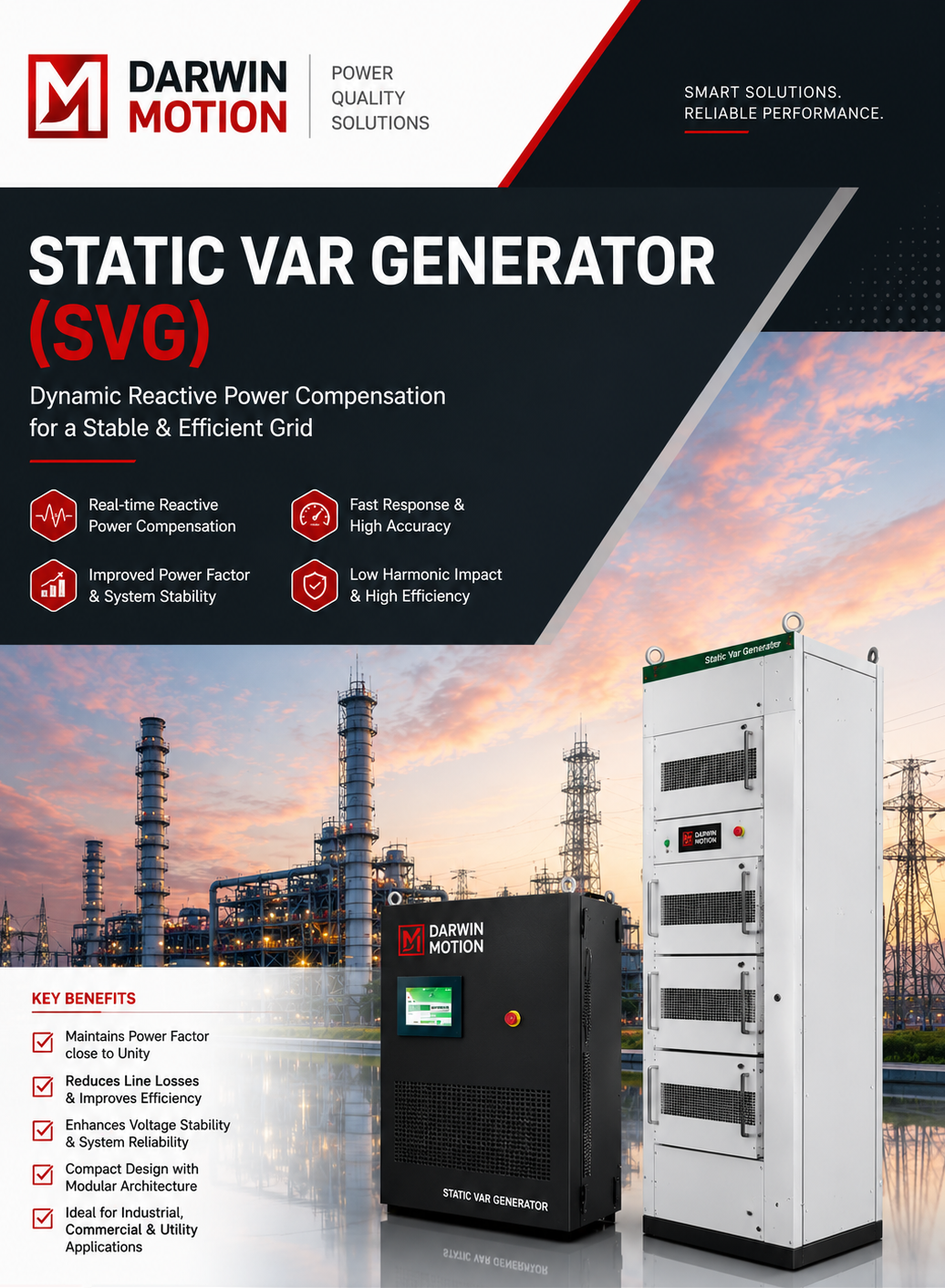
Darwin Motion's Static VAR Generator is designed to provide real-time reactive power compensation using high-speed IGBT technology and intelligent DSP control. According to Darwin Motion, its SVG can inject or absorb reactive power within milliseconds and maintain power factor close to unity under dynamic load conditions.
Reactive power itself does not perform useful mechanical work, but it is required by many inductive electrical loads to establish magnetic fields. When excessive reactive current flows through the electrical distribution system, it can increase the apparent power demand and contribute to additional losses.
Effective reactive power management can help industrial facilities optimize the capacity of their electrical infrastructure and improve overall power quality.
Automatic Power Factor Correction (APFC) panels have traditionally been used for reactive power compensation. They switch capacitor stages in response to changes in power factor.
However, many modern industrial loads change much faster than conventional capacitor switching systems can respond. Rapidly changing loads may therefore require a compensation technology capable of responding continuously and dynamically.
Darwin Motion positions its SVG as an alternative or complementary technology for applications requiring continuous, stepless and fast reactive power compensation.
The intelligence of a modern SVG comes from its ability to continuously measure the electrical system, determine the reactive power requirement and respond accordingly.
The system monitors electrical parameters and identifies the current reactive power requirement of the connected load.
Digital control technology processes the measured electrical parameters and determines whether the system requires capacitive or inductive compensation.
The power electronic converter generates the required compensation current without depending on conventional capacitor switching steps.
As the industrial load changes, the SVG continuously adjusts its output. This enables compensation to follow the actual operating condition of the facility.
By supplying the required reactive current dynamically, the system can help move the installation toward a higher power factor and reduce unnecessary reactive current circulation.
Darwin Motion AC Drive Manufacturer provides industrial automation and power-quality technologies for applications where energy efficiency, electrical reliability and precise control are important.
Its Static VAR Generator is designed as a dynamic reactive power compensation solution for industrial, commercial and infrastructure applications. Darwin Motion identifies applications including manufacturing, steel, cement, textile, chemical, pharmaceutical, HVAC, water treatment, data centers and renewable energy systems.
Darwin Motion lists a response time of approximately 5 ms, compensation capacities from 30 A to 600 A, system-voltage options from 208 V to 690 V AC, and power-factor performance up to 0.99 for its SVG range. Actual performance and sizing depend on the electrical system and application conditions.
Dynamic compensation can help maintain a high power factor even when the facility's load changes throughout the production cycle.
Compensating reactive power locally can reduce the amount of reactive current flowing through upstream cables, transformers and switchgear.
Reducing unnecessary current circulation can help minimize I²R losses in electrical distribution components.
Lower reactive current can free up part of the apparent-power capacity of transformers and distribution equipment, potentially allowing more useful active power to be delivered within existing infrastructure limits.
Rapid reactive power compensation can support voltage stability during changing load conditions, helping create a more stable electrical environment for connected equipment.
Maintaining an appropriate power factor can help industrial users manage utility requirements and avoid penalties where such charges apply.
Modern manufacturing processes can change electrical loading in fractions of a second. A fast electronic compensation system can respond significantly faster than conventional mechanical switching arrangements.
Darwin Motion describes its SVG as a solution without mechanical contactors or capacitor switching, which can reduce maintenance associated with conventional switching components.
Intelligent reactive power compensation is particularly valuable where electrical loads fluctuate frequently or where maintaining a stable power factor is important.
Manufacturing facilities often operate multiple motors, drives, compressors, pumps and automated machines simultaneously. Dynamic compensation can help manage the changing reactive power demand.
Large industrial motors, variable-speed equipment and other heavy electrical loads can create substantial and rapidly changing power requirements.
Cement manufacturing facilities operate large motors, conveyors, crushers, fans and other equipment. Reactive power management can support efficient utilization of plant electrical infrastructure.
Textile facilities use motors, VFDs, fans, pumps, compressors and other automated equipment. An intelligent compensation system can respond to changing production loads.
Large commercial and industrial HVAC installations may have continuously varying compressor, pump and fan loads, making dynamic compensation useful for maintaining electrical performance.
Data centers require highly reliable electrical infrastructure. Intelligent power-quality technologies can be considered as part of an overall electrical-system strategy.
Reactive power management can also be relevant in renewable-energy installations where grid-support and voltage-management requirements may vary with operating conditions.
| Parameter | Intelligent SVG | Conventional APFC |
|---|---|---|
| Compensation | Continuous and stepless | Step-based |
| Response | Millisecond-level electronic response | Slower switching response |
| Control | Digital intelligent control | Controller and capacitor stages |
| Dynamic Loads | Highly suitable | May have limitations |
| Mechanical Contactors | Not required for SVG compensation | Common in conventional APFC designs |
| Compensation Direction | Capacitive and inductive | Primarily capacitive |
| Load Adaptability | Automatic real-time adjustment | Dependent on capacitor-step configuration |
Reactive power compensation should not be viewed only as a method of correcting the power factor. In modern electrical installations, it can form part of a broader power-quality strategy.
Industrial facilities may have several simultaneous electrical challenges, including reactive power, harmonic distortion, load imbalance and voltage variations. The appropriate solution should therefore be selected after understanding the actual electrical characteristics of the installation.
Darwin Motion's power-quality portfolio includes Static VAR Generators, Active Harmonic Filters, Unified Power Quality Controllers and Dynamic Voltage Restorer technologies.
Choosing the appropriate compensation system requires more than simply selecting a capacity based on the connected load. A detailed electrical assessment can provide better results.
Darwin Motion is an AC Drive and industrial automation manufacturer serving customers in India and international markets. The company develops VFD, Servo Drive and power-quality technologies for industrial applications.
For facilities looking beyond basic motor control, Darwin Motion combines drive technology with power-quality solutions such as Static VAR Generators and Active Harmonic Filters.
As industrial electrical systems become more automated and dynamic, traditional fixed-step approaches to power-factor correction may not always provide the flexibility required by modern facilities. Loads can change rapidly, and reactive power demand can vary significantly throughout the operating cycle.
Intelligent Reactive Power Compensation provides a smarter approach by continuously monitoring electrical conditions and dynamically supplying or absorbing reactive power as required.
With its Static VAR Generator technology, Darwin Motion AC Drive Manufacturer offers a modern solution designed for real-time compensation, high power factor, voltage-support functions and improved utilization of electrical infrastructure.
For industrial facilities dealing with fluctuating loads, poor power factor or increasing reactive power demand, an appropriately engineered SVG-based solution can be an important step toward a more efficient and reliable electrical system.
It is a real-time approach to managing reactive power using intelligent power-electronic technology that continuously adjusts compensation according to changing electrical loads.
A Static VAR Generator is a power-electronic device that dynamically injects or absorbs reactive current to improve power factor and support voltage stability.
An SVG provides continuous, stepless and fast electronic compensation, while a conventional APFC panel generally uses switched capacitor stages to provide compensation in discrete steps.
Yes. Dynamic load compensation is one of the primary applications of SVG technology. Darwin Motion specifically describes its SVG as suitable for rapidly changing industrial loads.
Yes, depending on the electrical-system requirements. SVG technology primarily addresses reactive power, while an Active Harmonic Filter focuses on harmonic compensation. A power-quality study can determine whether a combined solution is appropriate.
Improve power-factor management and support efficient electrical-system operation with advanced Static VAR Generator technology from Darwin Motion.