

Posted on 31st Aug 2026
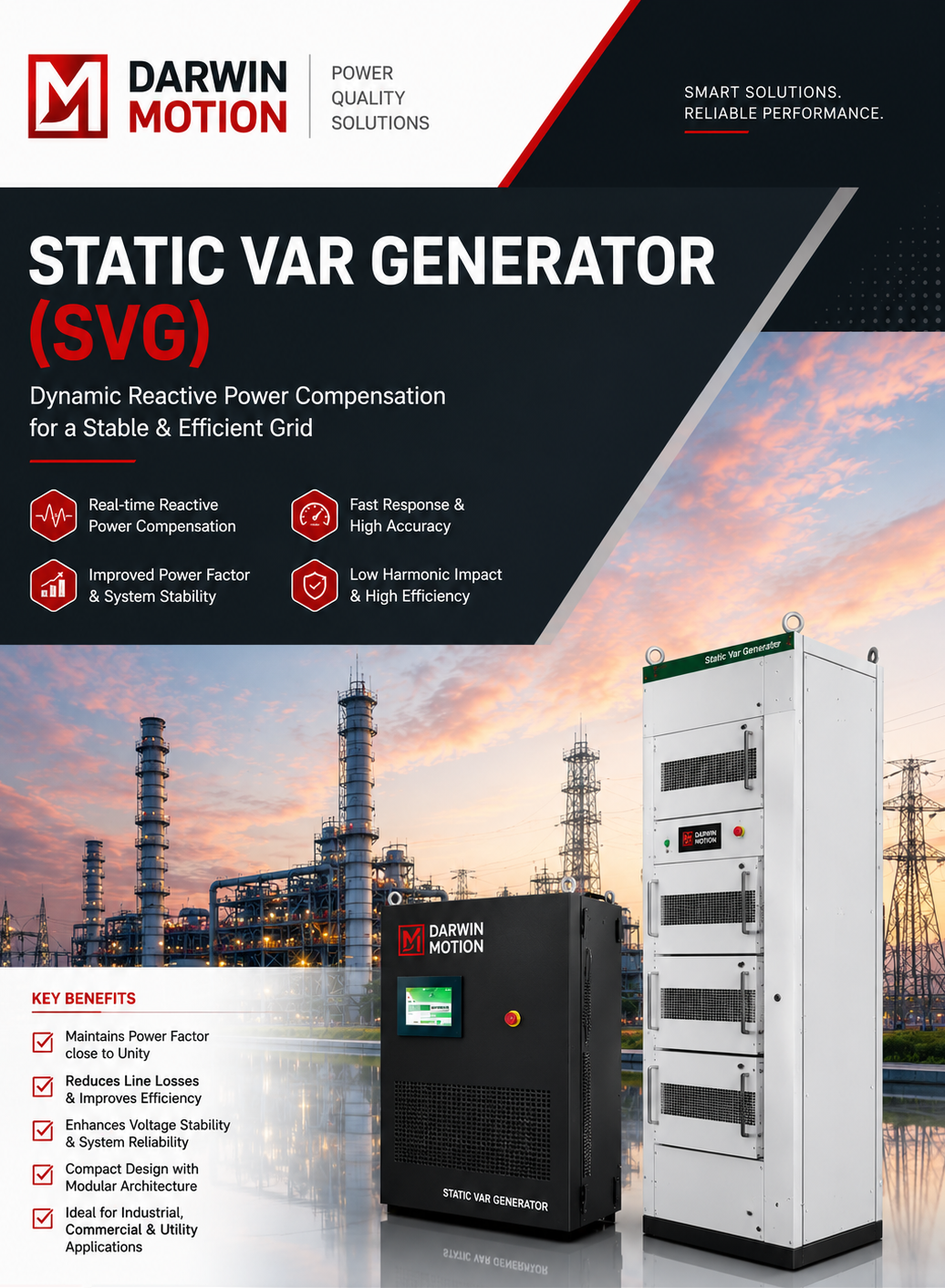
Modern industries are becoming increasingly dependent on high-performance electrical equipment, automated production systems, Variable Frequency Drives, compressors, pumps, welding machines, HVAC systems, CNC machines and other dynamic loads. While these technologies improve productivity, they can also create fluctuating reactive power demand within an industrial electrical network.
When reactive power is not managed effectively, industries may experience poor power factor, higher current demand, voltage fluctuations, increased distribution losses and reduced utilization of electrical infrastructure. This is where an Industrial SVG can provide a fast and intelligent solution for dynamic reactive power compensation.
A Static Var Generator (SVG) is a power-electronic device that continuously monitors the electrical system and dynamically injects or absorbs reactive current according to the instantaneous requirement of the load. Darwin Motion, a leading AC Drive manufacturer and industrial power quality solution provider, offers SVG technology designed for industrial, commercial and infrastructure applications.
An Industrial SVG, or Static Var Generator, is a modern reactive power compensation system designed to maintain electrical power factor and improve voltage stability in systems with rapidly changing loads.
Unlike conventional capacitor-based systems that generally operate through discrete switching steps, an SVG uses power electronics to provide continuous and stepless reactive power compensation. Darwin Motion's SVG uses high-speed IGBT technology and intelligent DSP control to respond to changing reactive power requirements within milliseconds.
Electrical equipment such as induction motors, transformers, compressors, pumps and other inductive loads require reactive power to establish their magnetic fields. Although reactive power does not directly perform useful mechanical work, it increases current flowing through the electrical distribution system.
Higher reactive current can result in greater loading of transformers, cables and switchgear. It can also contribute to lower power factor and increased electrical losses.
An SVG addresses this issue by dynamically supplying or absorbing the required reactive current close to the point where compensation is needed.
Industrial electrical loads rarely remain constant throughout the day. Production machines start and stop, motors accelerate and decelerate, welding equipment operates intermittently, and HVAC systems continuously adjust according to operating conditions.
These variations can make conventional fixed-step reactive power compensation less effective. A dynamic SVG can continuously respond to these changes rather than waiting for a capacitor bank step to switch in or out.
The operation of an SVG is based on real-time measurement and power-electronic compensation. The system continuously observes the electrical network and determines whether the load requires capacitive or inductive reactive power.
This continuous process enables an SVG to respond to dynamic electrical loads much faster than traditional mechanically switched capacitor systems.
Conventional Automatic Power Factor Correction (APFC) panels commonly use capacitor banks that are switched in stages according to the measured power factor. While this approach can be effective for relatively stable loads, rapidly changing industrial loads may require a more responsive technology.
An SVG provides continuous and stepless reactive power compensation without relying on mechanical contactors for every compensation adjustment.
One of the primary purposes of an SVG is to improve the power factor of an electrical installation. Darwin Motion's published SVG specifications indicate power factor improvement up to 0.99, depending on system conditions.
Industrial loads can change rapidly. SVG technology provides dynamic compensation by continuously injecting or absorbing reactive current according to the instantaneous requirements of the electrical system.
Improved power factor reduces unnecessary reactive current flowing through distribution equipment. This can help reduce I²R losses in transformers, cables and switchgear.
Reactive power variations can influence voltage conditions within an electrical network. By dynamically managing reactive power, an SVG can support a more stable voltage profile during changing load conditions.
Poor power factor increases apparent power demand. Improving power factor can reduce unnecessary reactive current and allow existing transformers and distribution equipment to be utilized more effectively.
Depending on the electricity tariff and utility regulations, poor power factor may result in additional charges or penalties. Maintaining a healthier power factor can help industries reduce such avoidable costs.
Lower unnecessary current circulation can reduce electrical stress and heating in distribution equipment, supporting reliable operation of transformers, cables, switchgear and motors.
The fast response of SVG technology makes it particularly useful in industries where electrical demand changes quickly during production cycles.
Industrial SVG systems can be deployed across a wide range of manufacturing and infrastructure environments where reactive power changes dynamically.
Production facilities with multiple motors, drives, compressors and automated machinery can benefit from dynamic reactive power management.
Large industrial motors and rapidly changing production loads can create significant reactive power variations. SVG technology can provide fast compensation for changing electrical demand.
Cement manufacturing facilities use large motors, crushers, mills, fans, conveyors and other heavy electrical loads. Dynamic reactive power compensation can help optimize the electrical distribution system.
Textile plants frequently operate multiple motors, drives, spinning machines, compressors and HVAC systems. An SVG can help maintain a stable power factor under changing production conditions.
Automotive plants use automated production lines, robotics, welding systems, motors and other electrical equipment. Dynamic power factor correction can be valuable where load conditions change frequently.
Process pumps, compressors, HVAC systems, motors and automated machinery can create varying reactive power demand. SVG systems can help maintain electrical efficiency and power factor.
Pumps, blowers, aeration systems and treatment equipment can operate at varying loads. SVG technology can dynamically compensate reactive power as operating conditions change.
Darwin Motion combines its expertise as an AC Drive manufacturer with advanced power quality technologies to address the electrical challenges faced by modern industries. Its Static Var Generator portfolio is designed for applications requiring fast reactive power compensation, improved power factor and better voltage stability.
Darwin Motion's published SVG solution uses high-speed IGBT technology and intelligent DSP control. The company specifies a response time of approximately 5 milliseconds, enabling the system to react quickly to changing reactive power requirements.
| Parameter | Specification |
|---|---|
| System Voltage | 208V – 690V AC |
| Frequency | 50/60 Hz |
| Compensation Capacity | 30A – 600A |
| Response Time | 5 ms |
| Power Factor | Up to 0.99 |
| Efficiency | >97% |
| Harmonic Compensation | 2nd – 50th Order |
| Cooling | Intelligent Forced Air |
| Communication | RS485 / Modbus RTU / Ethernet Optional |
| Display | 7-inch Touchscreen HMI |
The appropriate SVG capacity should be determined through an electrical system assessment, considering actual reactive power demand, load profile, transformer capacity and future expansion requirements. The specifications above reflect Darwin Motion's published product information.
Choosing an SVG should not be based solely on the total connected load of a facility. The actual reactive power requirement and dynamic behavior of the electrical system should be evaluated before finalizing the equipment rating.
Study how the plant's electrical load changes during production, startup, shutdown and peak operating conditions.
Record power factor under different operating conditions rather than relying on a single measurement.
The required SVG capacity should be calculated from measured reactive power demand and the desired target power factor.
If additional motors, production lines, VFDs or other electrical equipment are planned, the SVG system should be selected with future requirements in mind.
Depending on the electrical architecture, an SVG may be installed at a main distribution point or closer to a group of dynamic loads. The optimum location should be determined through an engineering assessment.
Energy efficiency in an industrial plant is not limited to reducing the active power consumed by machines. Efficient management of reactive power is also important because excessive reactive current increases the loading of electrical infrastructure.
By dynamically compensating reactive power, an SVG can help industries make better use of their electrical infrastructure while maintaining improved power factor and voltage conditions.
VFDs are widely used for controlling pumps, fans, compressors, conveyors and other industrial motors. As an AC Drive manufacturer, Darwin Motion develops drive solutions for industrial motor-control applications, while its SVG technology addresses reactive power management at the electrical-system level.
This combination enables industries to approach motor control and power quality as connected parts of an overall electrical efficiency strategy.
Industrial electrical systems require solutions that can adapt to real operating conditions. Darwin Motion provides a portfolio that extends beyond AC Drives into power quality technologies, including Static Var Generators, Active Harmonic Filters, Unified Power Quality Controllers and Dynamic Voltage Restorers.
Reactive power management is an important part of modern industrial electrical engineering. As factories adopt more automated machinery, VFDs, compressors, pumps, HVAC systems and other dynamic loads, traditional fixed-step compensation may not always provide the responsiveness required by the plant.
An Industrial SVG offers a modern approach by providing continuous, stepless and fast reactive power compensation. It can help improve power factor, reduce unnecessary reactive current, support voltage stability and optimize the utilization of electrical infrastructure.
With its combination of industrial automation expertise, AC Drive technology and advanced power quality solutions, Darwin Motion provides SVG technology for industries seeking more intelligent and responsive electrical power management.
An Industrial SVG is a Static Var Generator designed to dynamically compensate reactive power in industrial electrical systems. It continuously injects or absorbs reactive current according to the instantaneous requirements of the load.
The primary purpose of an SVG is to provide dynamic reactive power compensation, improve power factor and support voltage stability in electrical systems with changing loads.
An APFC panel generally uses capacitor stages that are switched according to the reactive power requirement, whereas an SVG uses power electronics to provide continuous and stepless compensation with a much faster response.
Yes. SVG systems can be used in industrial facilities containing VFDs, motors, compressors, pumps and other dynamic electrical loads. The actual system design should be based on the plant's measured electrical characteristics.
Industrial SVG technology can be used in manufacturing, automotive, steel, cement, textile, pharmaceutical, chemical, food processing, mining, water treatment and many other industrial environments. Darwin Motion lists these and several other sectors among its SVG application areas.
The required capacity depends on the facility's reactive power demand, load profile, desired power factor, electrical configuration and future expansion. A power quality study and site measurements are recommended before selecting the final SVG rating.
For detailed product information, applications and technical specifications, visit the Darwin Motion Static Var Generator product page.