

Posted on 24th Aug 2026
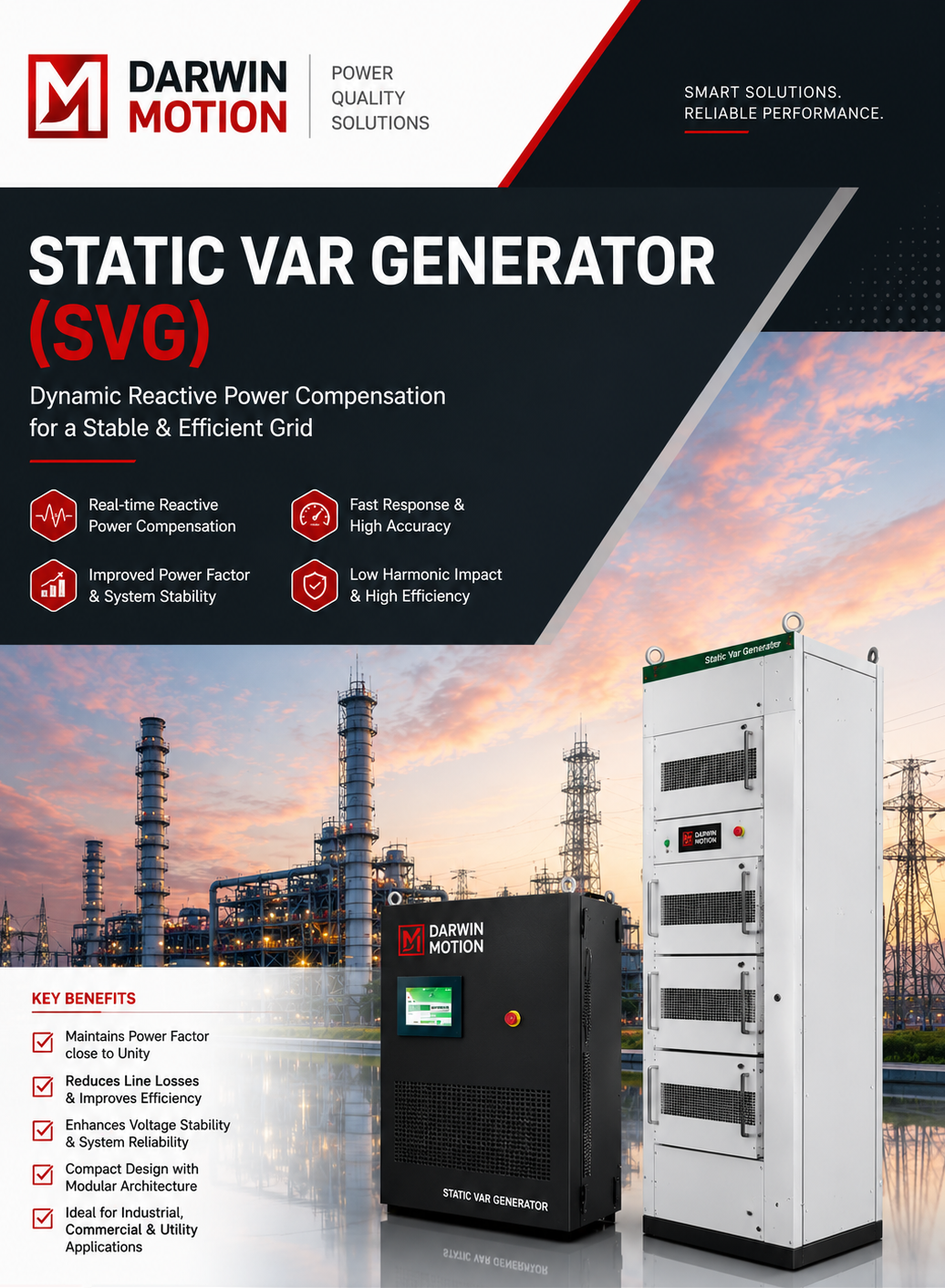
Efficient electrical power management is essential for modern industries where motors, drives, pumps, compressors, fans, production machines, and automated systems operate continuously. As industrial electrical loads become more sophisticated, maintaining a high power factor and stable power quality becomes increasingly important.
IGBT Power Factor Correction is an advanced approach to managing reactive power and improving the electrical characteristics of industrial systems. By using high-speed IGBT semiconductor technology, modern power-factor correction equipment can dynamically respond to changing loads and support more efficient utilization of electrical infrastructure.
Darwin Motion AC Drive Manufacturer provides advanced industrial automation and power-quality solutions for applications where energy efficiency, reliability, and precise electrical control are important. Darwin Motion's technology portfolio includes AC drives and solutions designed for industrial applications.
IGBT Power Factor Correction is a power-electronic technique that uses Insulated Gate Bipolar Transistors (IGBTs) to control current and compensate reactive power. Unlike conventional fixed compensation methods, an active electronic system can respond dynamically to variations in electrical demand.
IGBTs are high-speed switching devices commonly used in modern power converters and AC drives. Their fast switching capability allows electronic power systems to precisely control current and voltage according to application requirements. Darwin Motion's AC drive documentation also describes IGBT-based inverter technology in its drive systems.
Power factor indicates how effectively an electrical system converts supplied apparent power into useful real power. A lower power factor can result in higher current for the same useful power demand, increasing loading on transformers, cables, switchgear, and other distribution equipment.
Improving power factor can therefore help industrial facilities make better use of their existing electrical infrastructure while potentially reducing losses and improving overall system performance.
The key advantage of IGBT-based power conversion is its ability to switch rapidly and control electrical current electronically. An active correction system can monitor the electrical network and generate the required compensating current according to changing operating conditions.
This makes IGBT-based solutions particularly suitable for industrial environments where loads are not constant throughout the production cycle.
Industrial equipment rarely operates at one fixed load level. Motors may accelerate or decelerate, pumps may respond to process requirements, and production machinery can switch between different operating modes.
An active IGBT-based correction system can be designed to respond to these changes dynamically rather than relying solely on fixed compensation.
AC drives and Variable Frequency Drives (VFDs) are widely used for controlling motor speed and torque. Their electronic power-conversion stages provide major benefits in terms of motor control and energy management, but their interaction with the electrical supply must also be considered when assessing power quality.
Darwin Motion notes that VFD systems can be associated with power-quality considerations such as harmonics and power-factor issues. Appropriate mitigation and system design can help improve the performance of installations using multiple drives.
Improving the power factor can reduce unnecessary current flow and help decrease electrical losses in the distribution network. This can contribute to more efficient utilization of electrical power.
Transformers, cables, switchgear, and distribution systems have finite current and capacity ratings. Better power factor can help reduce unnecessary current loading and improve utilization of available electrical capacity.
One of the important advantages of active IGBT technology is its ability to respond to changing electrical conditions. This is valuable for manufacturing facilities where equipment loads vary throughout the production process.
Properly designed power-quality equipment can help maintain healthier electrical conditions for industrial equipment and support stable operation of connected loads.
Modern factories increasingly depend on automated production lines, electronically controlled motors, robotics, pumps, compressors, and intelligent drive systems. Advanced power-quality solutions complement these technologies by helping maintain suitable electrical operating conditions.
IGBT-based power-factor correction can be considered for a wide range of industrial and commercial applications where dynamic electrical loads require responsive compensation.
Conventional capacitor banks are commonly used for power-factor correction. They can provide effective reactive-power compensation when the load is relatively predictable and the system has been appropriately engineered.
Active IGBT-based systems offer a different approach. Because they use power electronics and real-time control, they can provide dynamic compensation for changing load conditions.
Darwin Motion is an industrial automation technology company offering AC drives, drive systems, and related solutions. The company states that its solutions are intended to help customers improve energy efficiency, asset reliability, productivity, safety, and performance.
Darwin Motion also provides drive technologies across different industrial applications, making its expertise relevant to facilities that require reliable motor control and improved energy management.
Selecting a power-factor correction solution should begin with an assessment of the electrical installation. Rather than selecting equipment solely according to connected load, engineers should examine actual operating conditions and electrical measurements.
Before implementing an active correction system, electrical measurements can provide valuable information about the installation. Monitoring voltage, current, real power, reactive power, apparent power, power factor, and harmonic distortion can help engineers understand the actual behavior of the network.
This information allows the correction system to be selected according to real operating requirements rather than assumptions based only on equipment nameplate ratings.
Power-factor correction equipment should be integrated with the electrical architecture of the facility. Incorrect sizing or unsuitable compensation can create additional electrical problems. A professional assessment can help determine the appropriate technology, capacity, installation point, protection, and control strategy.
The continued adoption of industrial automation, variable-speed motors, electronically controlled equipment, and intelligent energy-management systems is increasing the importance of advanced power electronics.
IGBT technology provides a foundation for high-speed electronic control and is already used extensively in modern drive and power-conversion systems. As industries focus increasingly on energy efficiency and reliable operation, intelligent power-quality management is expected to remain an important part of industrial electrical design.
IGBT Power Factor Correction represents an advanced method for improving the utilization and quality of electrical power in industrial installations. Its dynamic electronic control makes it particularly useful for applications where electrical loads change frequently and conventional fixed compensation may not provide the required flexibility.
For industries looking to improve motor-control performance and overall electrical efficiency, working with an experienced Darwin Motion AC Drive Manufacturer can provide access to modern industrial automation and power-quality technologies.
Explore the IGBT Power Factor Correction solution from Darwin Motion to learn more about advanced power-quality and electrical compensation technology for industrial applications.