

Posted on 11th Sep 2026
Efficient electrical power management is essential for modern industries where motors, variable frequency drives, compressors, welding machines, HVAC equipment, CNC systems, and other electrical loads operate continuously. One of the important factors affecting electrical efficiency is power factor. When a facility operates with a poor power factor, the electrical network may experience increased reactive current, higher losses, reduced available system capacity, and additional utility charges.
Electronic Power Factor Correction provides a modern approach to managing reactive power and maintaining a stable power factor. Instead of relying only on conventional capacitor switching, electronic power factor correction systems can respond dynamically to changing electrical loads.
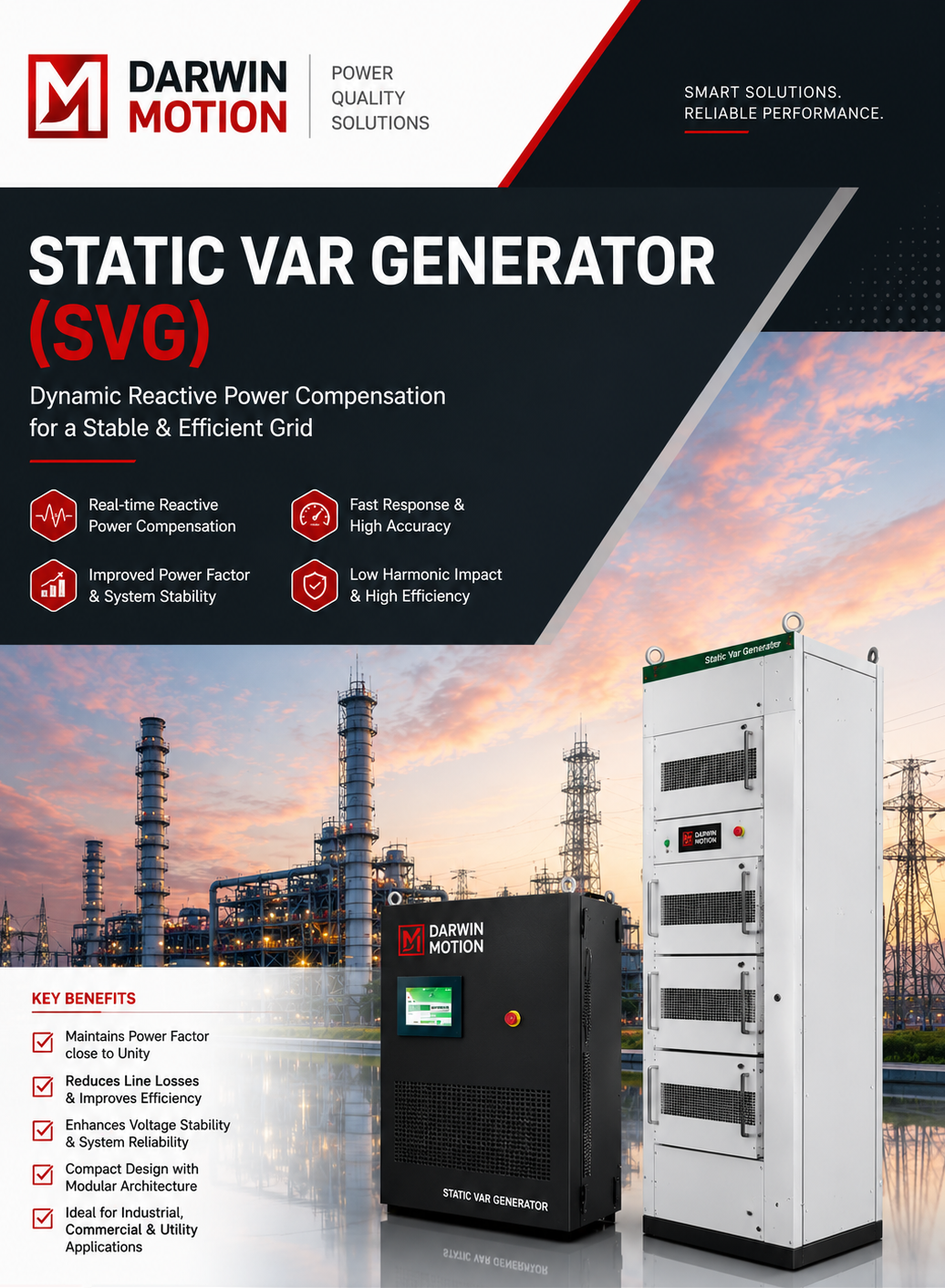
Darwin Motion AC Drive Manufacturer offers advanced power-quality solutions based on power-electronics technology, including Static Var Generator (SVG) systems designed for real-time reactive power compensation and power-factor improvement.
Electronic Power Factor Correction is a technology-based method of improving the power factor of an electrical installation by electronically controlling reactive power. It uses power semiconductor devices, control processors, current sensing, and intelligent switching techniques to compensate for reactive power requirements.
A modern electronic correction system can continuously monitor the electrical network and determine whether reactive current needs to be supplied or absorbed. This makes it particularly useful in facilities where electrical demand changes rapidly throughout the production cycle.
Power factor represents the relationship between useful active power and apparent power in an electrical system. A power factor closer to unity generally indicates that electrical power is being utilized more effectively.
Inductive loads such as motors, transformers, compressors, and certain industrial machines require reactive power to establish magnetic fields. This reactive component increases current flow without directly performing useful mechanical work. Electronic compensation technology can help manage this reactive component and improve overall system performance.
Industrial electrical loads are rarely constant. Production machinery can start, stop, accelerate, decelerate, or change operating conditions throughout the day. Conventional power-factor correction systems based on fixed capacitor steps may not always respond accurately to these rapid changes.
Electronic compensation provides a dynamic alternative by responding to the actual reactive-power requirement of the network. Darwin Motion's Static Var Generator is designed to provide continuous and stepless reactive power compensation for dynamic loads.
Electronic power factor correction works by continuously observing the electrical parameters of a system. The controller determines the reactive power requirement and commands the power-electronic converter to compensate for the required reactive current.
In Darwin Motion's SVG technology, high-speed IGBT devices and intelligent DSP control are used to dynamically inject or absorb reactive power. The company's published specifications state a response time of approximately 5 milliseconds.
A Static Var Generator, commonly known as an SVG, is a power-electronic device designed to provide dynamic reactive power compensation. Unlike traditional capacitor banks that switch predefined steps, an SVG can provide continuous compensation according to the changing requirements of the electrical system.
Darwin Motion describes its SVG as a real-time reactive power compensation solution capable of improving power factor, supporting voltage stability, and optimizing electrical-system efficiency.
Manufacturing facilities and commercial installations often have electrical loads that vary significantly. For example, welding equipment may create rapidly changing demand, while motors and compressors can change their reactive power requirements depending on operating conditions.
Because an SVG continuously monitors and compensates reactive power, it can be better suited to such variable operating environments than fixed-step correction systems.
Automatic Power Factor Correction (APFC) panels traditionally use capacitor banks that are switched in and out according to the reactive power demand. Although this approach remains useful for many applications, it may have limitations when loads change quickly.
Electronic power-factor correction using SVG technology takes a different approach by using power electronics for continuous compensation. Darwin Motion highlights continuous, stepless compensation, fast response, and the absence of conventional capacitor switching as advantages of its SVG solution.
Dynamic reactive power compensation can help maintain a power factor closer to unity. Darwin Motion specifies power factor performance of up to 0.99 for its SVG solution.
Improving power factor can reduce unnecessary reactive current flowing through transformers, cables, and switchgear. Lower current can contribute to reduced resistive losses in the electrical distribution network.
Reactive power has an important relationship with voltage conditions in electrical networks. Dynamic reactive compensation can help support voltage stability when electrical loads change.
Reducing unnecessary reactive current can free a portion of the apparent-power capacity of transformers and distribution equipment, potentially allowing existing infrastructure to support more useful active power.
Depending on the electricity tariff and utility requirements, maintaining an appropriate power factor can help reduce charges associated with poor power factor or excessive reactive-energy consumption.
Electronic compensation is particularly useful where the reactive power requirement changes frequently. The compensation output can continuously follow the electrical demand rather than relying on fixed capacitor stages.
Electronic power factor correction can be used in a broad range of industrial, commercial, infrastructure, and renewable-energy installations. Darwin Motion lists applications including manufacturing, automotive, steel, cement, textiles, pharmaceuticals, data centers, solar power plants, wind energy systems, EV charging infrastructure, and rail-related installations.
Manufacturing facilities frequently operate motors, VFDs, compressors, welding machines, pumps, and automated production equipment. Dynamic reactive compensation can help maintain suitable power-quality conditions as machinery changes operating states.
Automotive plants often contain large numbers of motors, robotic systems, welding equipment, and automated production lines. Electronic power factor correction can help address changing reactive-power requirements throughout production processes.
Heavy industrial machinery can create substantial and variable electrical demand. Dynamic compensation can be useful where large motors and production equipment cause rapid changes in reactive power.
Data centers require stable and reliable electrical infrastructure. Electronic power-quality equipment can complement the facility's broader electrical-management strategy by supporting power factor and voltage conditions.
Modern renewable-energy installations use power electronic converters and may operate alongside changing industrial or grid conditions. Darwin Motion identifies solar power plants and wind energy systems among the applications for its SVG technology.
Darwin Motion AC Drive Manufacturer provides AC drives and advanced power-quality technologies for industrial and infrastructure applications. Alongside its drive portfolio, the company offers solutions such as Static Var Generators, Active Harmonic Filters, Unified Power Quality Controllers, Dynamic Voltage Restorers, and other reactive-power and power-quality systems.
This combination of AC drive and power-quality technology is valuable for facilities where variable-speed motors and other power-electronic equipment operate together. A coordinated approach to motor control and electrical power quality can help businesses improve operational efficiency and manage demanding electrical environments.
Darwin Motion publishes a range of electrical specifications for its Static Var Generator. These specifications can help engineers evaluate the technology for different industrial and commercial power systems.
Selecting a suitable electronic compensation system requires an understanding of the facility's electrical profile. The system should be selected based on actual reactive-power requirements rather than simply choosing a capacity based on connected load.
As industrial facilities become increasingly automated, electrical loads are becoming more dynamic. Variable-speed drives, robotics, automation systems, welding equipment, compressors, HVAC systems, and digitally controlled machines can all create changing electrical conditions.
Traditional fixed-step approaches may not always provide the level of responsiveness required by these modern facilities. Electronic power factor correction provides a flexible method of managing reactive power while adapting to changing operating conditions.
With fast electronic control, continuous compensation, and intelligent monitoring, SVG technology can form an important part of a modern power-quality strategy.
Electronic Power Factor Correction is an effective approach for facilities that need accurate and dynamic reactive-power management. By continuously monitoring the electrical system and compensating reactive current electronically, modern solutions can help improve power factor, reduce electrical losses, support voltage stability, and make better use of existing electrical infrastructure.
Darwin Motion AC Drive Manufacturer combines AC drive expertise with advanced power-quality solutions such as Static Var Generators. Its SVG technology is designed for real-time reactive power compensation and is suitable for applications ranging from manufacturing plants and heavy industries to commercial facilities, data centers, renewable-energy systems, and infrastructure projects.
For organizations looking to improve electrical efficiency and manage rapidly changing reactive-power requirements, an appropriately engineered electronic compensation system can provide a modern alternative to conventional power-factor correction methods.
Electronic Power Factor Correction uses power-electronic technology to dynamically compensate reactive power and improve the power factor of an electrical system.
SVG stands for Static Var Generator. It is a power-electronic device that dynamically injects or absorbs reactive power to support power factor and voltage stability.
A conventional APFC panel generally uses switched capacitor steps, whereas an SVG provides continuous and stepless electronic reactive-power compensation. This makes SVG technology particularly suitable for rapidly changing loads.
Improving power factor can reduce unnecessary reactive current, which can help lower resistive losses in electrical distribution components such as cables and transformers.
Electronic power factor correction can be used in manufacturing, automotive, steel, cement, textile, pharmaceutical, commercial, data-center, renewable-energy, EV charging, and other applications with dynamic electrical loads.
Darwin Motion offers AC drives alongside power-quality products including Static Var Generators and Active Harmonic Filters. Its SVG technology is designed for dynamic reactive-power compensation, with published features including fast response, continuous compensation, intelligent DSP control, and modular scalability.