
Posted on 20th Aug 2026
Modern industrial electrical systems are becoming increasingly dependent on variable-speed equipment, automated machinery, welding systems, compressors, pumps, motors, and other electronically controlled loads. These applications can cause rapid changes in reactive power demand, resulting in poor power factor, voltage fluctuations, and increased loading of electrical infrastructure.
Dynamic Reactive Power Compensation provides a flexible approach to managing rapidly changing reactive power requirements. By responding to variations in electrical demand, dynamic compensation technology can help maintain a more stable power system while improving the utilization of transformers, cables, generators, and other electrical equipment.
Darwin Motion AC Drive manufacturer provides industrial automation and power-electronics solutions designed for applications where efficient electrical control and dependable power quality are important.
Reactive power is associated with the magnetic and electric fields required by many AC electrical devices. Motors, transformers, inductive equipment, and other loads can consume reactive power even though this power does not perform useful mechanical work in the same way as active power.
Dynamic reactive power compensation uses power-electronic equipment to respond to changing reactive power requirements. Instead of relying solely on fixed compensation, a dynamic system can adjust its output according to the real-time condition of the electrical network.
Industrial loads rarely remain constant. A production line may start motors, change operating speeds, switch machines on and off, or experience sudden variations in electrical demand. Consequently, the reactive power requirement can change within a short period.
A dynamic compensation system can follow these changes and provide appropriate reactive power support, helping the electrical system operate more efficiently and consistently.
AC electrical systems contain three closely related concepts: active power, reactive power, and apparent power. Active power is responsible for useful work, while reactive power supports the magnetic or electric fields required by many electrical devices. Apparent power represents the combined electrical demand on the supply system.
Active power, generally measured in kilowatts (kW), represents the portion of electrical power converted into useful work, heat, light, or other energy output.
Reactive power, measured in kilovolt-amperes reactive (kVAR), is associated with the energy exchanged between inductive or capacitive components and the electrical source.
Apparent power, measured in kilovolt-amperes (kVA), represents the total electrical loading experienced by the supply infrastructure.
Dynamic compensation equipment continuously monitors electrical parameters and determines the amount of reactive power required by the system. Power-electronic switching technology can then generate or absorb reactive current to counteract the changing demand.
This operating principle allows compensation to occur rapidly, making the technology suitable for installations where reactive power demand changes frequently.
Dynamic compensation can provide several advantages when appropriately engineered for an industrial electrical installation.
Maintaining a healthier power factor can reduce the amount of reactive current drawn from the electrical supply. This can improve the utilization of available electrical capacity.
Transformers, cables, generators, and switchgear are affected by the total current flowing through the system. Reducing unnecessary reactive current can help make better use of existing electrical capacity.
One of the key advantages of dynamic compensation is its ability to respond to fluctuating loads. This is especially useful in automated manufacturing environments where equipment changes operating conditions frequently.
Reactive power has a direct relationship with voltage behavior in electrical networks. Appropriate compensation can support voltage stability, particularly in systems experiencing significant variations in load.
Lower reactive current can reduce current-dependent losses in electrical distribution components. The actual improvement depends on the characteristics and operating conditions of the individual installation.
Conventional capacitor banks are widely used for power factor correction. However, fixed or stepped capacitor systems may not always be ideal for applications with rapidly changing reactive power requirements.
Dynamic compensation provides a different approach by continuously adjusting the compensating response instead of depending only on fixed capacitor steps.
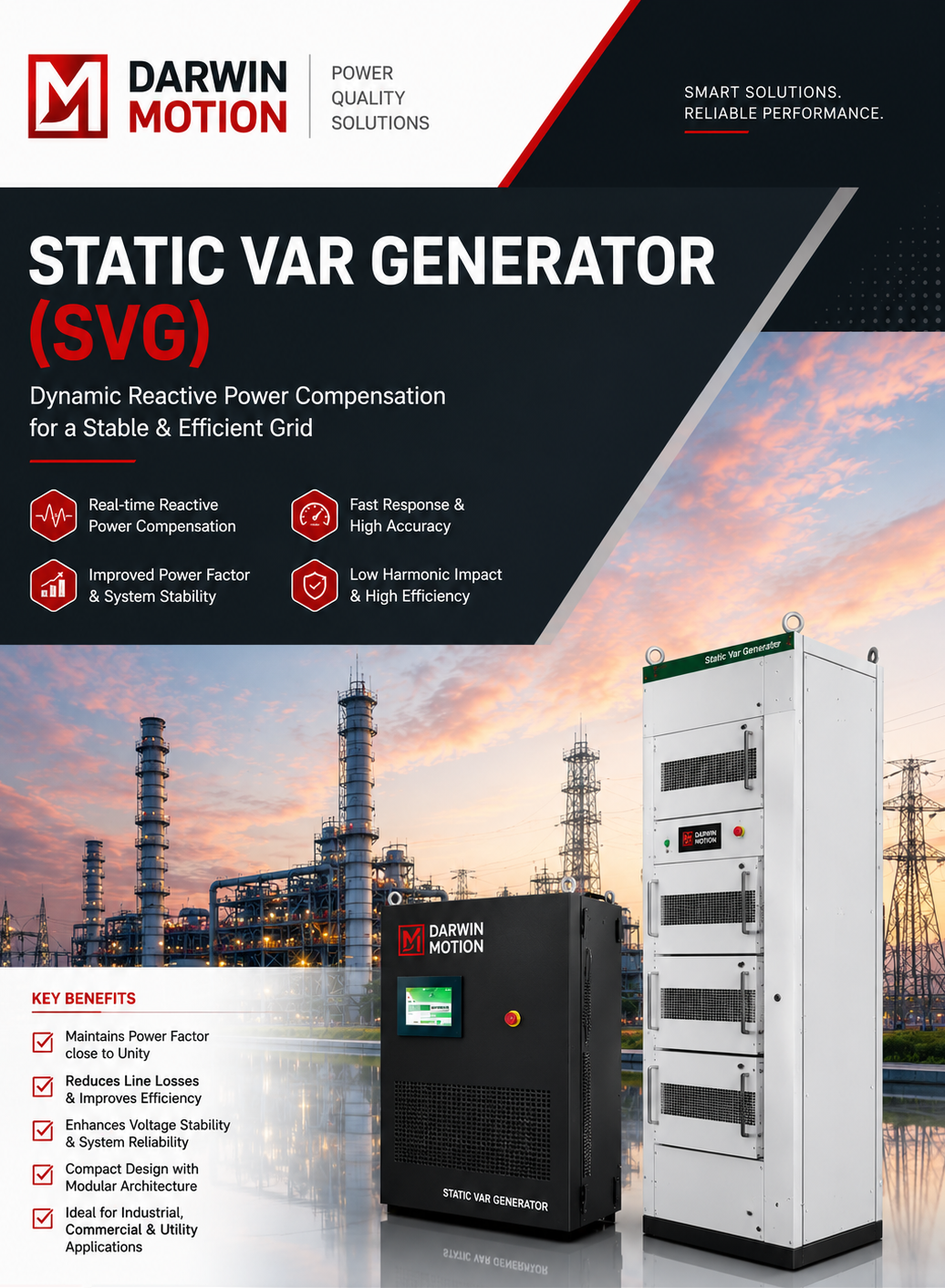
A Static Var Generator (SVG) is a power-electronic solution used for dynamic reactive power compensation. It can provide controllable reactive current according to the requirements of the electrical network.
SVG technology is particularly relevant for applications where reactive power demand changes quickly. Its electronic control architecture enables fast adjustment compared with conventional mechanical switching approaches.
Darwin Motion AC Drive manufacturer focuses on industrial automation and electrical drive technology for applications requiring controlled and efficient motor operation. AC drives play an important role in modern facilities by controlling motor speed, torque, and operating conditions.
When AC drives and other power-electronic equipment are integrated into an industrial facility, power quality becomes an important part of overall electrical-system design. Reactive power compensation can complement an energy-efficient drive system by addressing reactive power requirements elsewhere in the electrical network.
As an industrial automation technology provider, Darwin Motion can support applications where motor control, energy management, and power-quality considerations need to be addressed as part of an integrated electrical solution.
Manufacturing facilities often contain numerous motors and automated machines operating at different times and load levels. Dynamic compensation can help address changing reactive power requirements across the production environment.
Welding machines can introduce rapidly varying electrical loads. Such fluctuations can make dynamic compensation particularly useful for maintaining desired electrical operating conditions.
Pumps, fans, compressors, and HVAC equipment can have changing reactive power requirements, particularly when their operating speed or loading changes. Dynamic compensation can work alongside variable-speed drive technology to support overall power quality.
Renewable-energy installations may require reactive power management to support grid integration and voltage control. The appropriate compensation strategy depends on the generation technology and grid requirements.
A suitable compensation solution should be selected after evaluating the actual electrical characteristics of the installation rather than relying solely on connected load capacity.
Industrial facilities are becoming increasingly automated and electrically sophisticated. Motors, drives, converters, robotic systems, welding equipment, and automated machinery can produce electrical conditions that vary considerably during normal operation.
For this reason, power-quality management should be considered as part of the complete electrical design. Dynamic reactive power compensation provides a controllable method for managing reactive power when electrical demand is continuously changing.
Dynamic Reactive Power Compensation can play an important role in modern electrical power management. By dynamically responding to reactive power requirements, the technology can support power factor improvement, voltage stability, electrical capacity utilization, and overall power quality.
Static Var Generator technology provides a fast and electronically controlled approach to reactive power management, making it suitable for industrial facilities with fluctuating electrical loads.
With its focus on industrial automation and drive technology, Darwin Motion AC Drive manufacturer offers solutions for modern industrial applications where efficient motor control and effective electrical-system management are important. A detailed site assessment should be performed before selecting the capacity and configuration of any dynamic reactive power compensation system.
It is a power-management technique that dynamically supplies or absorbs reactive current to match changing reactive power requirements within an electrical system.
A Static Var Generator is a power-electronic device capable of dynamically controlling reactive current to support power factor and voltage conditions.
Yes. When properly sized and configured, dynamic reactive power compensation can reduce reactive power drawn from the supply and improve the overall power factor.
It can be particularly suitable for installations where reactive power requirements change rapidly, such as manufacturing, welding, automated production, and other variable-load applications.