

Posted on 21st Aug 2026
Industrial electrical systems are becoming increasingly dynamic. Motors, variable frequency drives, compressors, pumps, welding machines, cranes, furnaces and automated production equipment can change their electrical demand within very short periods. When reactive power demand changes rapidly, maintaining a consistently high power factor becomes more challenging with conventional correction methods.
This is where Dynamic Power Factor Correction can provide a more responsive approach to reactive power management. By continuously monitoring electrical conditions and adjusting reactive power compensation according to the instantaneous requirement, modern electronic compensation technology can help industries maintain a stable and efficient electrical network.
Darwin Motion, an AC Drive manufacturer, focuses on industrial drive and power-quality technologies designed to support efficient motor control and improved electrical-system performance. Its portfolio includes solutions for industrial applications where energy efficiency, automation and power quality are important considerations.
Dynamic Power Factor Correction is a method of automatically compensating reactive power as the electrical load changes. Unlike conventional fixed or stepped compensation systems, dynamic compensation can continuously adjust its output according to the actual reactive-power requirement of the connected load.
In a typical industrial installation, inductive loads such as motors and transformers require reactive power for their operation. If this reactive demand is supplied entirely through the utility network, the system may experience a lower power factor and higher apparent-current demand.
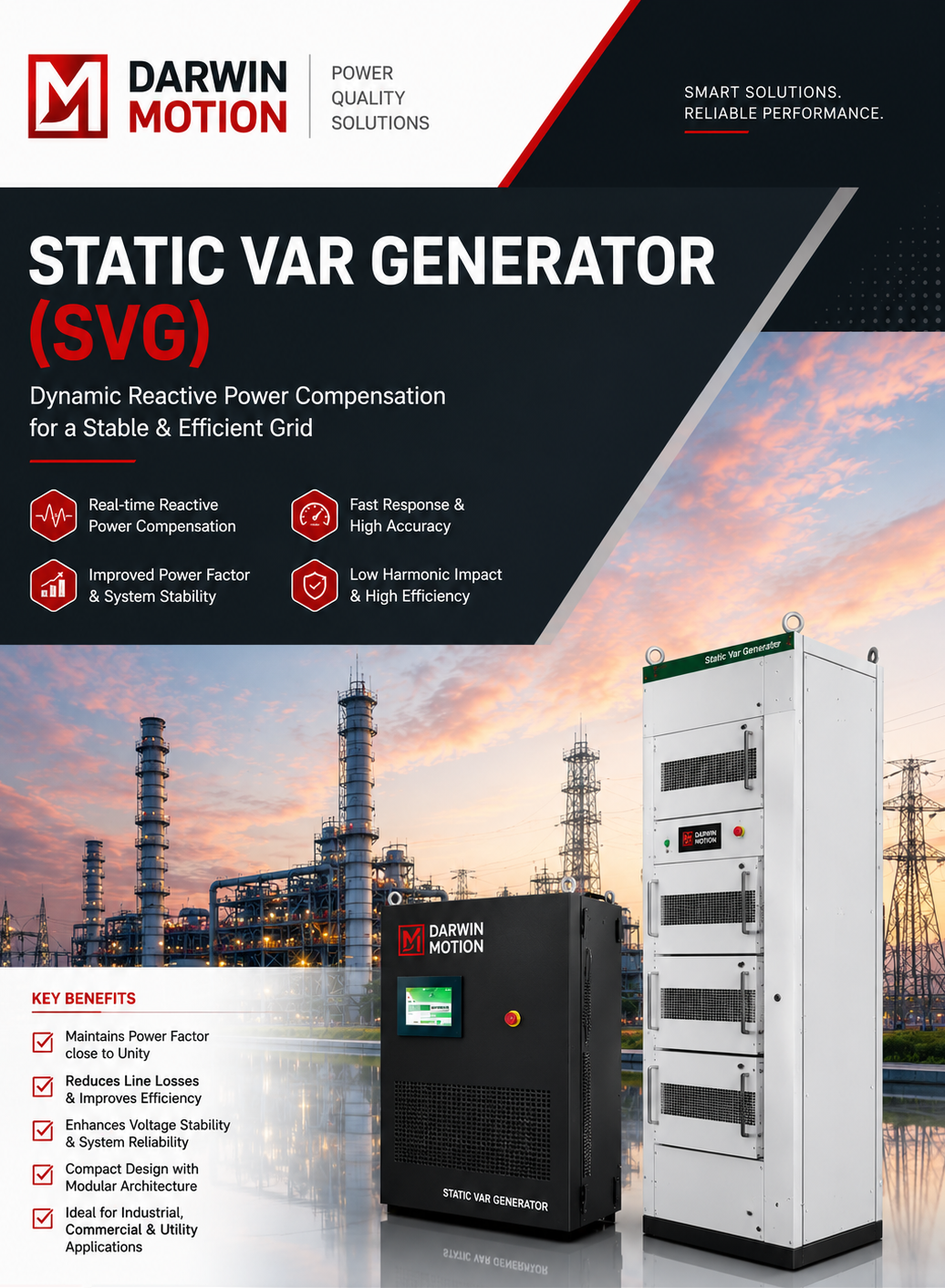
A dynamic compensation system detects the electrical condition and supplies or absorbs reactive power as required. Static Var Generator (SVG) technology is one modern approach used for this purpose, with electronic power converters providing fast and stepless reactive-power compensation.
Power factor indicates how effectively electrical power is being converted into useful work. A lower power factor means that a greater apparent current may be required to deliver the same active power.
Low power factor can therefore affect the utilization of transformers, cables, switchgear and other electrical infrastructure. Reactive-power compensation can reduce the reactive component drawn from the upstream supply and help improve the utilization of the electrical system.
A dynamic power-factor correction system generally uses current and voltage measurements to determine the electrical characteristics of the load. A controller processes this information and determines whether reactive power needs to be supplied or absorbed.
With an SVG-based solution, power electronics are used to generate a controlled compensation current. The system can continuously adapt the amount and direction of reactive-power compensation instead of relying solely on discrete capacitor steps. SVG systems are designed for both capacitive and inductive reactive-power compensation.
Conventional automatic power-factor correction systems generally use capacitor banks switched in stages. This approach can be effective for relatively stable loads, but rapidly changing loads may create a requirement for more responsive compensation.
Dynamic electronic compensation provides stepless adjustment and rapid response, making it particularly suitable for applications where reactive-power demand changes frequently. Modern SVG systems are designed to react quickly to load changes and provide continuous compensation.
Industrial loads can change quickly during production cycles. Dynamic compensation can track these changes and adjust reactive-power support accordingly. This makes the technology particularly relevant for applications such as cranes, welders, furnaces and other fluctuating loads.
By compensating reactive power closer to the point where it is required, a dynamic system can help maintain a higher power factor across varying operating conditions.
When reactive power is compensated locally, the upstream electrical network may need to supply less reactive current. This can help improve the utilization of electrical distribution infrastructure.
Reducing unnecessary reactive current can help reduce associated losses in electrical distribution components. The actual energy-saving potential depends on the plant configuration, operating profile and existing power factor.
Reactive-power control is closely associated with voltage behavior in electrical systems. Dynamic reactive-power compensation can support voltage stability in suitable applications, particularly where load changes occur rapidly.
Because electronic compensation can be controlled continuously, the system can avoid the coarse step changes associated with conventional staged compensation.
Dynamic control can continuously match compensation to the load requirement, reducing the possibility of significant over- or under-compensation associated with improperly sized fixed or stepped systems.
Dynamic power-factor correction is especially relevant where electrical loads are variable, rapidly changing or difficult to predict.
SVG and STATCOM-based reactive-power compensation is used across demanding applications including metallurgical facilities, rolling mills and arc-furnace environments, where reactive-power demand can fluctuate significantly.
Modern industrial plants increasingly use variable frequency drives to control motor speed, torque and process output. AC drives can provide significant advantages in process control and energy management, but the overall electrical system still needs to be evaluated for power factor, harmonics and other power-quality parameters.
Darwin Motion AC Drive technology is designed for industrial motor-control applications, including demanding sectors such as steel and manufacturing. Darwin Motion describes its drive solutions as supporting applications where energy efficiency and process control are important.
For a plant containing numerous motor-driven loads, combining efficient AC drive technology with an appropriately engineered reactive-power compensation system can form part of a broader power-quality strategy.
A Static Var Generator, commonly referred to as an SVG, uses power-electronic conversion technology to generate or absorb reactive current. The controller continuously evaluates the electrical system and controls the converter according to the required compensation.
This operating principle makes SVG technology particularly useful where the load does not remain constant. Instead of waiting for a capacitor stage to switch, the compensation system can dynamically follow the reactive-power requirement.
Depending on the equipment configuration, advanced SVG systems may provide functions beyond basic power-factor correction, including phase-load balancing and reactive-power management. Some systems can also incorporate harmonic compensation capabilities.
Choosing a dynamic compensation system should begin with an assessment of the existing electrical network rather than simply selecting a product based on connected load.
A plant with a relatively constant reactive load may have different compensation requirements from a facility where the load changes dramatically every few seconds. A load study helps determine the appropriate compensation capacity, control strategy and installation point.
Power factor and harmonics are related power-quality considerations, but they are not identical. A system can have an acceptable displacement power factor while still experiencing significant harmonic distortion.
For this reason, a complete electrical assessment should examine both reactive-power demand and harmonic conditions. Where harmonic distortion is significant, the compensation architecture should be designed carefully to avoid creating unwanted interactions between capacitors, system impedance and harmonic currents.
Some SVG technologies can combine reactive-power compensation with harmonic and load-balancing functions, depending on their design and configuration.
Darwin Motion is an AC Drive manufacturer serving industrial automation and motor-control applications. Its technology portfolio is focused on industrial electrical and automation requirements, with solutions designed for demanding applications.
For industries seeking to modernize their electrical infrastructure, dynamic reactive-power compensation can complement an overall strategy involving efficient drives, harmonic management, load optimization and intelligent energy monitoring.
Modern manufacturing facilities require more than simply supplying electrical power to production equipment. They need electrical systems capable of responding to rapidly changing loads while maintaining efficiency, reliability and power quality.
Dynamic Power Factor Correction provides a responsive approach to reactive-power management by continuously adjusting compensation according to changing electrical conditions. Static Var Generator technology can provide fast, stepless reactive-power compensation and is particularly relevant for industrial facilities with fluctuating loads.
As an AC Drive manufacturer, Darwin Motion brings industrial motor-control expertise together with power-quality solutions to address the evolving requirements of modern manufacturing. For plants experiencing fluctuating power factor, reactive-power demand or broader electrical power-quality challenges, a properly engineered dynamic compensation solution can be an important part of the overall electrical-system strategy.
Dynamic Power Factor Correction is a real-time method of compensating reactive power according to changing electrical load conditions. It is designed to maintain an improved power factor even when the reactive-power requirement varies rapidly.
An SVG, or Static Var Generator, is a power-electronic device that can dynamically generate or absorb reactive current to compensate inductive or capacitive reactive power.
Yes. It can be particularly useful in factories where motors, welding machines, cranes, furnaces, compressors or other equipment create rapidly changing reactive-power requirements.
Yes. Dynamic reactive-power compensation can be implemented in industrial electrical systems containing AC drives. However, the complete system should be evaluated for power factor, harmonics, load profile and other power-quality parameters.
Reactive-power compensation can reduce unnecessary reactive current and associated distribution losses in appropriate installations. The actual energy savings depend on the existing electrical system, load profile and operating conditions.
For industrial applications requiring responsive reactive-power management and improved electrical performance, explore the Darwin Motion Static Var Generator solution:
Dynamic Power Factor Correction – Darwin Motion Static Var Generator