
Posted on 9th Sep 2026
Modern industrial electrical systems are becoming increasingly dynamic. Motors, pumps, compressors, Variable Frequency Drives, welding machines, HVAC equipment, CNC machinery and automated production systems frequently change their operating conditions throughout the manufacturing process. These variations can cause the reactive power demand of an electrical network to fluctuate continuously.
When reactive power is not managed effectively, the electrical system may experience a lower power factor, increased current flow, higher distribution losses, reduced transformer utilization and possible utility-related power factor charges.
Dynamic Power Factor Correction provides an intelligent approach to these changing electrical conditions. Instead of relying only on fixed or stepped compensation, modern power-electronic solutions can monitor the electrical system and provide reactive power compensation according to the actual load requirement.
Darwin Motion, a leading AC Drive manufacturer and power-quality solution provider, offers Static VAR Generator technology designed for real-time reactive power compensation in industrial, commercial and infrastructure applications.
Dynamic Power Factor Correction is a method of continuously adjusting reactive power compensation according to the instantaneous requirements of an electrical system.
In a conventional power factor correction arrangement, capacitor banks are commonly switched in predefined steps. This approach can work effectively for relatively stable loads, but rapidly changing loads may create periods of under-compensation or over-compensation.
Dynamic correction uses power-electronic technology to provide a much more responsive solution. A Static VAR Generator can detect the reactive power requirement and dynamically inject or absorb reactive current to bring the system power factor closer to the desired operating condition.
Power factor indicates how effectively an electrical system utilizes the supplied apparent power. A low power factor means that more current may be required to deliver the same amount of useful active power.
Higher current can increase loading on transformers, cables and switchgear and can contribute to additional electrical losses.
Traditional Automatic Power Factor Correction systems generally use capacitor banks that are switched according to predefined steps. While this method remains useful for many applications, it can become less suitable when reactive power demand changes quickly.
Industrial facilities with cranes, welding systems, compressors, VFD-driven machinery and other fluctuating loads can experience rapid variations in reactive power demand.
For facilities where the load profile changes frequently, a power-electronic compensation system can provide a more responsive approach.
A dynamic power factor correction system continuously observes electrical parameters and determines the reactive power requirement of the connected load.
Current and voltage conditions are monitored continuously through the system's measurement and control arrangement.
The control system determines whether the electrical network requires capacitive or inductive reactive power compensation.
The required compensation level is calculated according to the instantaneous electrical condition rather than relying on fixed compensation steps.
The power-electronic converter generates the required compensation current and supplies it to the electrical network.
As the electrical load changes, the compensation output changes accordingly. This creates a continuously adaptive power factor correction process.
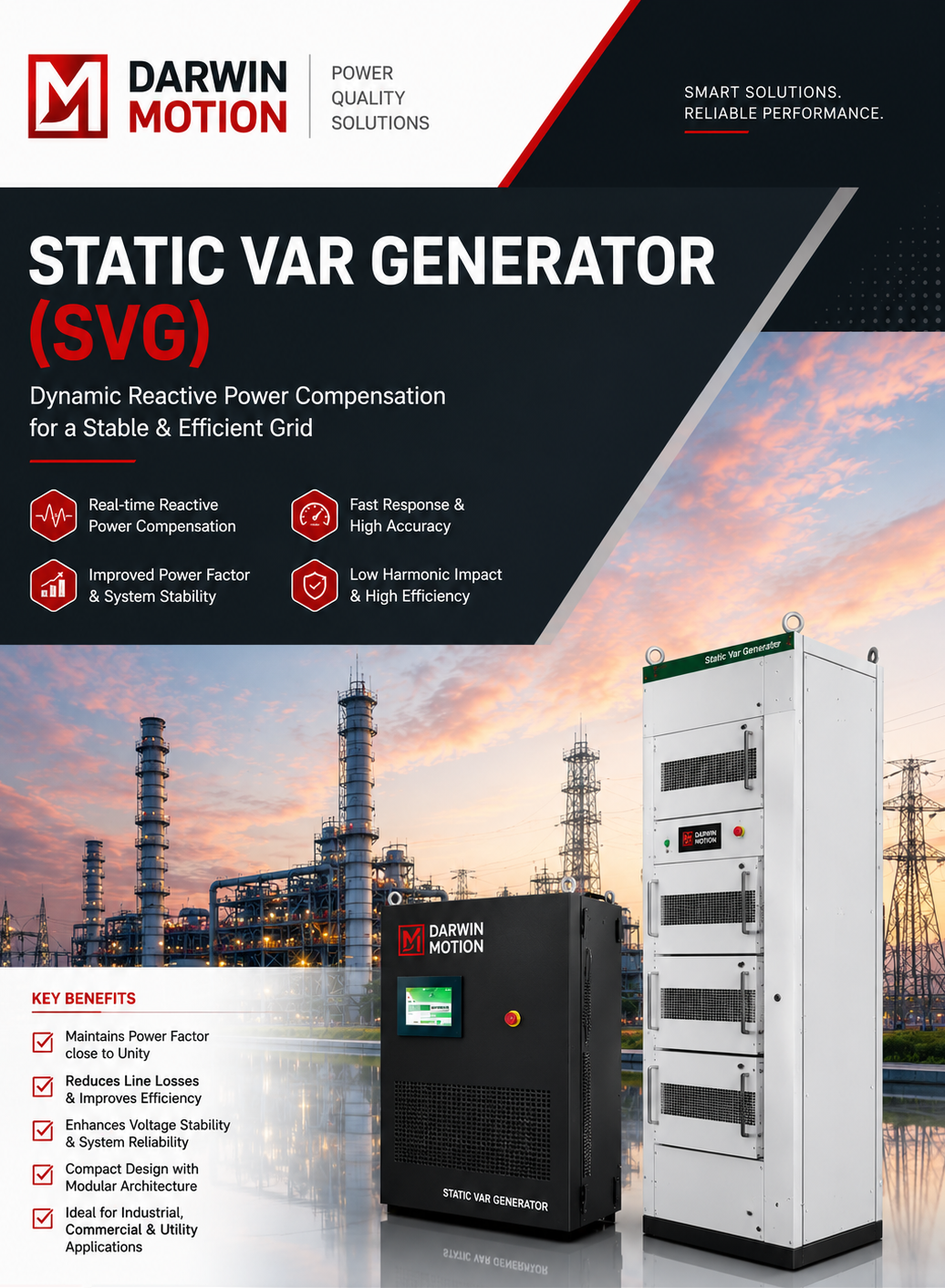
A Static VAR Generator, commonly referred to as an SVG, is a power-electronic solution for dynamic reactive power compensation. Darwin Motion's SVG is designed to dynamically inject or absorb reactive power and maintain power factor close to the desired operating level.
According to Darwin Motion's published product information, its SVG uses high-speed IGBT technology and intelligent DSP control. The company specifies continuous stepless compensation, capacitive and inductive compensation, automatic load detection, voltage stabilization and three-phase load balancing among its features.
Dynamic compensation can help maintain a high power factor even when the electrical load changes during production operations.
By supplying reactive power closer to the point of demand, dynamic compensation can reduce unnecessary reactive current flowing through upstream electrical infrastructure.
Reducing unnecessary current can help decrease I²R losses in electrical conductors, transformers and distribution equipment.
Improved power factor can reduce the apparent-power burden associated with reactive current, potentially making better use of available transformer capacity.
Dynamic compensation is particularly valuable in facilities where machines frequently start, stop or change operating conditions.
Because compensation is continuously adjusted according to system requirements, dynamic systems can avoid some of the over- and under-compensation conditions associated with fixed-step systems.
Reactive power management can contribute to a more stable electrical operating environment, particularly in facilities with rapidly changing loads.
Variable Frequency Drives are widely used for controlling motors in pumps, fans, conveyors, compressors and industrial machinery. As an AC Drive manufacturer, Darwin Motion understands the importance of coordinating motor-control technology with overall electrical power-quality requirements.
Industrial facilities with large numbers of VFD-driven loads may have complex electrical characteristics. A power-quality assessment can determine whether dynamic reactive power compensation, harmonic mitigation or a combined solution is appropriate for the installation.
Dynamic power factor correction can be beneficial wherever reactive power demand changes significantly during normal operation.
Darwin Motion lists these types of industrial, commercial and infrastructure applications for its SVG technology.
Manufacturing facilities commonly operate several types of electrical loads simultaneously. Motors, compressors, pumps, welding machines, conveyors and automated production equipment can produce changing reactive power requirements.
During production peaks, the reactive demand may increase significantly, while during idle periods it may decrease. A dynamic compensation system can adjust its output according to these operating conditions.
The primary difference is the way compensation is delivered. Conventional APFC generally controls capacitor stages, whereas an SVG-based solution uses power electronics for continuous reactive current compensation.
| Parameter | Dynamic SVG | Conventional APFC |
|---|---|---|
| Compensation | Continuous and stepless | Step-based |
| Response | Very fast | Dependent on switching and control sequence |
| Reactive Power Direction | Inductive and capacitive | Primarily capacitor-based correction |
| Dynamic Loads | Highly suitable | May be less responsive |
| Mechanical Contactors | Not required for electronic compensation | Commonly used |
| Scalability | Modular | Based on capacitor stages |
The appropriate technology should ultimately be selected after evaluating the site's load profile, reactive power requirement, voltage level, harmonics and electrical-system configuration.
Darwin Motion is an AC Drive manufacturer offering motor-control and power-quality technologies for industrial and commercial applications. Its product portfolio includes AC Drives as well as Static VAR Generators, Active Harmonic Filters and other power-quality solutions.
This combination of AC Drive and power-quality expertise enables Darwin Motion to address electrical-system requirements associated with modern industrial automation and power-electronic loads.
Darwin Motion's published specifications list 208–690 V AC system-voltage options, 30–600 A compensation capacity and a stated 5 ms response time, depending on configuration.
Selecting the correct compensation system requires more than simply matching the connected load capacity. A detailed electrical assessment helps determine the required compensation capacity and system configuration.
Reactive power compensation and harmonic filtering are related but technically distinct power-quality functions. An SVG primarily addresses reactive power and power factor, while an Active Harmonic Filter is designed specifically to compensate unwanted harmonic currents.
Where an electrical installation has both low power factor and significant harmonic distortion, the complete power-quality profile should be evaluated before selecting the appropriate solution.
Darwin Motion offers both SVG and Active Harmonic Filter technologies, allowing power-quality requirements to be considered according to the characteristics of the individual installation.
As industrial electrical systems become more automated and dynamic, maintaining a stable power factor requires solutions that can respond to changing reactive power demand. Conventional stepped compensation may not always provide the response required by rapidly changing industrial loads.
Dynamic Power Factor Correction using Static VAR Generator technology provides a modern approach by continuously monitoring the electrical system and dynamically supplying or absorbing reactive power according to the instantaneous requirement.
With its expertise as an AC Drive manufacturer and power-quality solution provider, Darwin Motion offers SVG technology designed for dynamic reactive power compensation, power factor improvement and electrical-system optimization across a wide range of industrial and commercial applications.
Explore Darwin Motion Static VAR Generator:
https://darwinmotion.com/static-var-generator.php
Dynamic Power Factor Correction is a method of continuously adjusting reactive power compensation according to the real-time requirements of an electrical load.
A Static VAR Generator, or SVG, is a modern power-electronic device used for continuous and dynamic reactive power compensation.
An SVG provides continuous, stepless compensation and can respond dynamically to changing reactive power requirements, whereas conventional capacitor banks generally operate through discrete stages.
Improved power factor can reduce unnecessary reactive current in the electrical distribution system, which can help reduce associated distribution losses.
Darwin Motion combines expertise in AC Drives and power-quality technologies. Its SVG solution is designed for real-time reactive power compensation, power factor improvement, voltage stabilization and dynamic industrial load applications.